Question
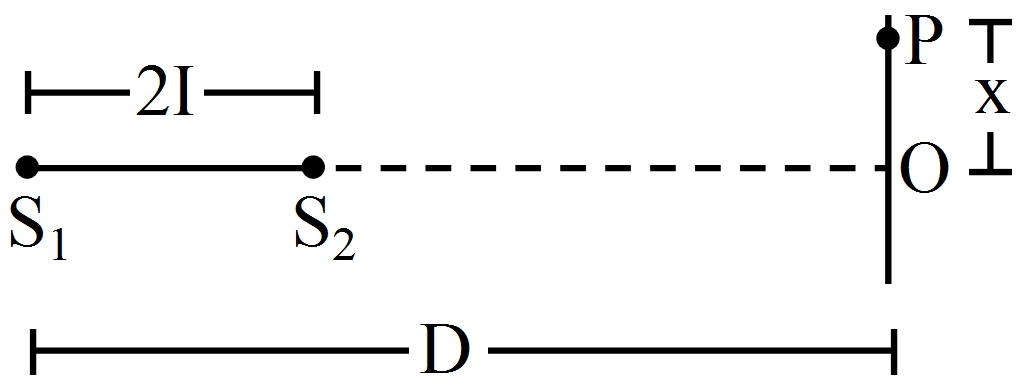
Two coherent narrow slits emitting sound of wavelength $\lambda$ in the same phase are placed parallel to each other at a small separation of $2\lambda.$ The sound is detected by moving a detector on the screen $\sum$ at a distance $\text{D}(>>\lambda)$ from the slit $S_1$ as shown in figure. Find the distance $x$ such that the intensity at $P$ is equal to the intensity at $0.$
Answer

Given: $S_1 S_2$ are in the same phase. At $O,$ there will be maximum intensity.
There will be maximum intensity at $P$.
From the $($in questions$)$ : $\triangle\text{S}_1\text{PO}$ and $\triangle\text{S}_2\text{PO}$ are right $-$ angled triangle
So, $(\text{S}_1\text{P})^2-(\text{S}_2\text{P})^2$$=\big[\text{D}^2+\text{x}^2\big]-\Big[(\text{D}-2\lambda)^2+\text{x}^2\Big]^2$
$=4\lambda\text{D}+4\lambda^2=4\lambda\text{D}$
$\Big(\lambda^2$ is small and can be neglected$\Big)$
$\Rightarrow(\text{S}_1\text{P}+\text{S}_2\text{P})(\text{S}_1\text{P}-\text{S}_2\text{P})=4\lambda\text{D}$
$\Rightarrow(\text{S}_1\text{P}-\text{S}_2\text{P})=\frac{4\lambda\text{D}}{(\text{S}_1\text{P}+\text{S}_2\text{P})}$
$\Rightarrow\text{S}_1\text{P}-\text{S}_2\text{P}=\frac{4\lambda\text{D}}{2\sqrt{\text{x}^2+\text{D}^2}}$
For constructive interference, path difference $=\text{n}^\lambda$
So, $\text{S}_1\text{P}-\text{S}_2\text{P}=\frac{4\lambda\text{D}}{2\sqrt{\text{x}^2+\text{D}^2}}=\text{n}\lambda$
$\Rightarrow\frac{2\text{D}}{\sqrt{\text{x}^2+\text{D}^2}}=\text{n}$
$\Rightarrow\text{n}^2\big(\text{x}^2+\text{D}^2\big)=4\text{D}^2$
$\Rightarrow\text{n}^2\text{x}^2+\text{n}^2\text{D}^2=4\text{D}^2$
$\Rightarrow\text{n}^2\text{x}^2=4\text{D}^2-\text{n}^2\text{D}^2$
$\Rightarrow\text{n}^2\text{x}^2=\text{D}^2(4-\text{n}^2)$
$\Rightarrow\text{x}=\frac{\text{D}}{\text{n}}\sqrt{4-\text{n}^2}$
When $n = 1,\text{x}=\sqrt{3}\text{D} \ (1^{st} $ order$)$.
When $ n = 2,\text{x}=0 \ (2^{nd}$ order$).$
So when $\text{x}=\sqrt{3}\text{D},$ the intensity at $P$  is equal to the intensity at $O$.

Need a full question paper?

Generate a complete, print-ready paper with questions like this in minutes — across 16+ boards, with answer keys.

Start Generating Free

Similar questions

Calculate the energy released by $1g$ of natural uranium assuming $200\ MeV$ is released in each fission event and that the fissionable isotope $^{235}U$ has an abundance of $0.7\%$ by weight in natural uranium.
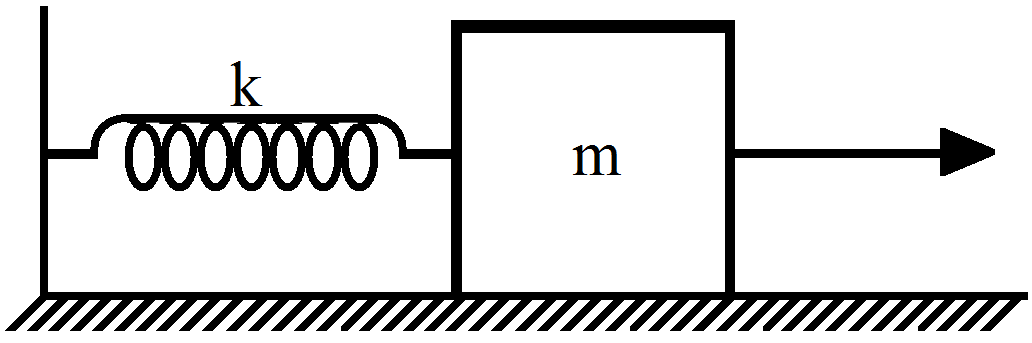
The spring shown in figure is unstretched when a man starts pulling on the cord. The mass of the block is M. If the man exerts a constant force F, find
  1. The amplitude and the time period of the motion of the block,
  2. The energy stored in the spring when the block passes through the equilibrium position and,
  3. The kinetic energy of the block at this position.
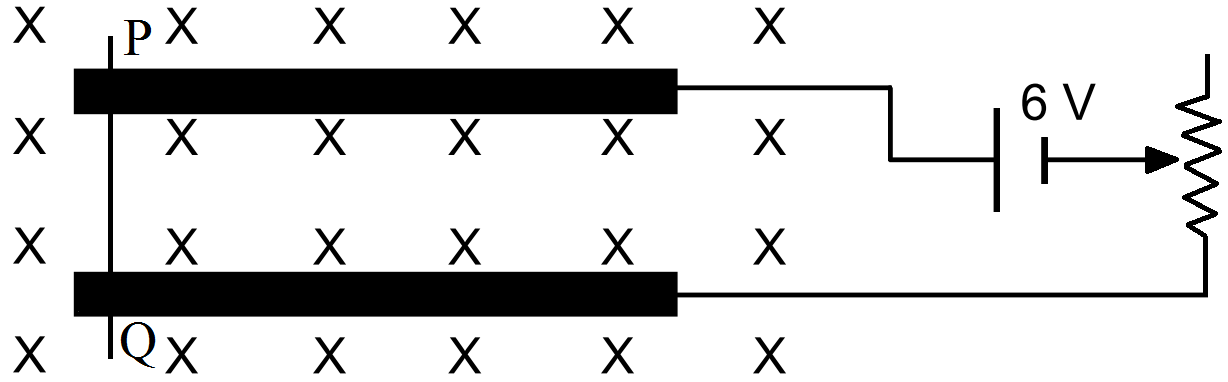
A metal wire PQ of mass 10g lies at rest on two horizontal metal rails separated by 4.90cm A vertically-downward magnetic field of magnitude 0.800T exists in the space. The resistance of the circuit is slowly decreased and it is found that when the resistance goes below 20.0Ω, the wire PQ starts sliding on the rails. Find the coefficient of friction.
The focal lengths of a convex lens for red, yellow and violet rays are 100cm, 98cm and 96cm respectively. Find the dispersive power of the material of the lens.
Concentric equipotential surfaces due to a charged body placed at the centre are shown. Identify the polarity of the charge and draw the electric field lines due to it.
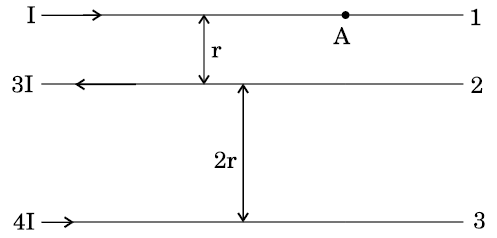
The figure shows three infinitely long straight parallel current carrying conductors. Find the
  1. magnitude and direction of the net magnetic field at point A lying on conductor 1,
  2. magnetic force on conductor 2.
A spherical volume contains a uniformly distributed charge of density $2.0 \times 10^{-4}Cm^{-3}.$ Find the electric field at a point inside the volume at a distance $4.0\ cm$ from the centre.
A circular coil of $16$ turns and radius $10 \ cm$ carrying a current of $0.75 A$ rests with its plane normal to an external field of magnitude $5.0 \times 10^{–2} T.$ The coil is free to turn about an axis in its plane perpendicular to the field direction. When the coil is turned slightly and released, it oscillates about its stable equilibrium with a frequency of $2.0 s^{–1}.$ What is the moment of inertia of the coil about its axis of rotation?
A series $\text{LCR}$ circuit with $R = 20\Omega , L = 1.5H$ and $C = 35\mu F$ is connected to a variable$-$frequency $200V$ ac supply. When the frequency of the supply equals the natural frequency of the circuit, what is the average power transferred to the circuit in one complete cycle?
  1. What characteristic property of nuclear force explains the constancy of binding energy per nucleon (BE/A) in the range of mass number 'A' lying 30
    • Show that the density of nucleus over a wide range of nuclei is constantindependent of mass numberA.