Question 13 Marks
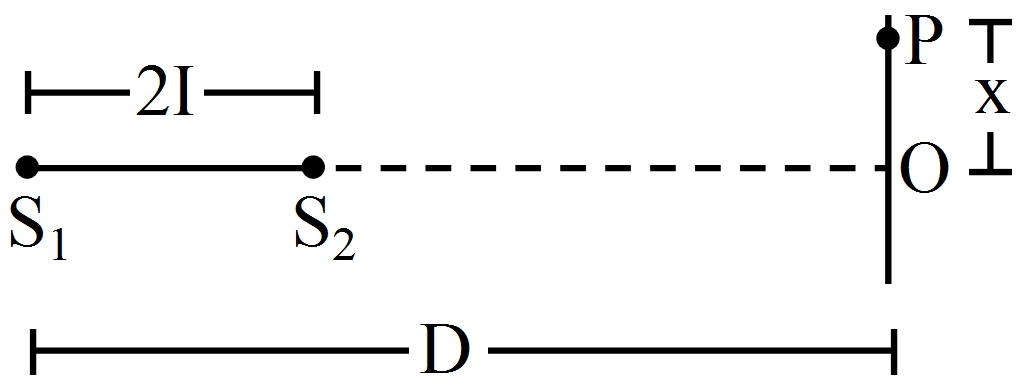
Two sources of sound $, S_1$ and $S_2,$ emitting waves of equal wavelength $20.0\ cm,$ are placed with a separation of $20.0\ cm$ between them. A detector can be moved on a line parallel to $S_1 ,S_2,$ and at a distance of $20.0\ cm$ from it. Initially, the detector is equidistant from the two sources. Assuming that the waves emitted by the sources are in phase, find the minimum distance through which the detector should be shifted to detect a minimum of sound.
Answer
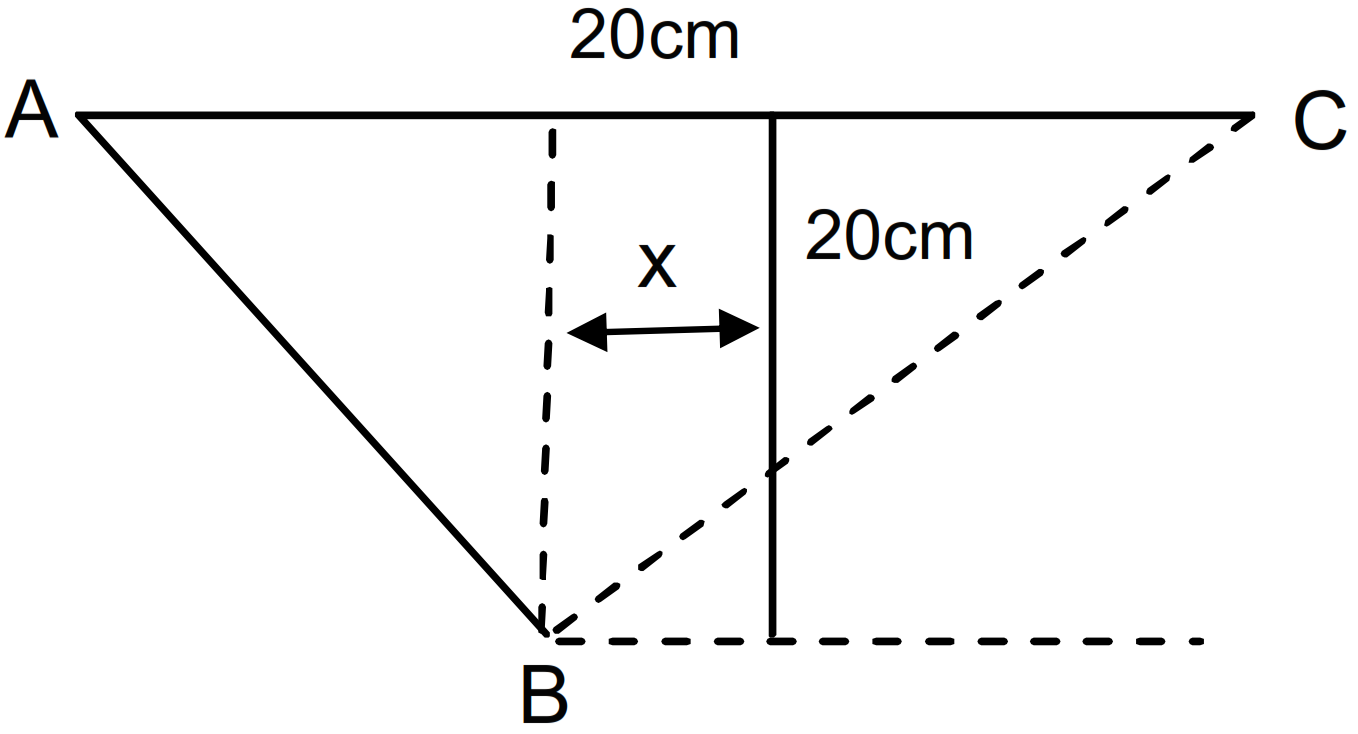
According to the data
$\lambda=20\text{ cm},\text{S}_1\text{S}_2=20\text{ cm},\text{BD}=20\text{ cm}$
Let the detector is shifted to left for a distance $x$ for hearing the minimum sound.
So path difference $\text{AI}=\text{BC}-\text{AB}$
$=\sqrt{(20)^2+(10+\text{x})^2}-\sqrt{(20)^2+(10-\text{x})^2}$
So the minimum distances hearing for minimum
$=\frac{(2\text{n}+1)\lambda}{2}=\frac{\lambda}{2}=\frac{20}{2}=10\text{ cm}$
$=\sqrt{(20)^2+(10+\text{x})^2}-\sqrt{(20)^2+(10-\text{x}^2)}=10$
Solving we get $x = 12.0\ cm.$
View full question & answer→According to the data
$\lambda=20\text{ cm},\text{S}_1\text{S}_2=20\text{ cm},\text{BD}=20\text{ cm}$
Let the detector is shifted to left for a distance $x$ for hearing the minimum sound.
So path difference $\text{AI}=\text{BC}-\text{AB}$
$=\sqrt{(20)^2+(10+\text{x})^2}-\sqrt{(20)^2+(10-\text{x})^2}$
So the minimum distances hearing for minimum
$=\frac{(2\text{n}+1)\lambda}{2}=\frac{\lambda}{2}=\frac{20}{2}=10\text{ cm}$
$=\sqrt{(20)^2+(10+\text{x})^2}-\sqrt{(20)^2+(10-\text{x}^2)}=10$
Solving we get $x = 12.0\ cm.$
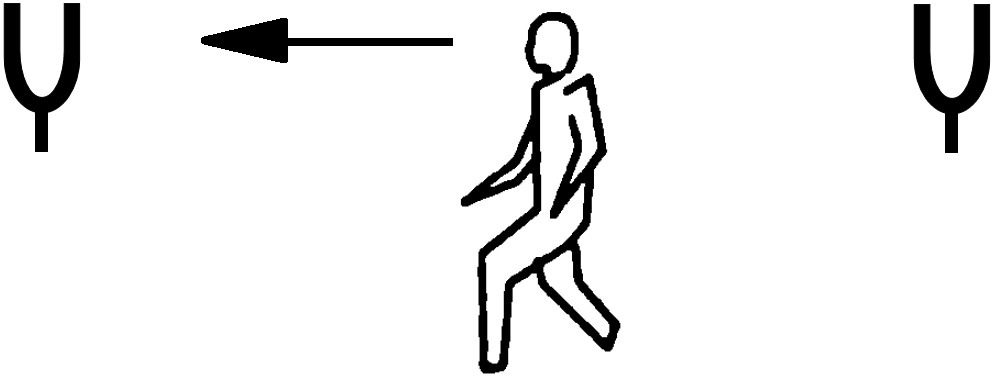
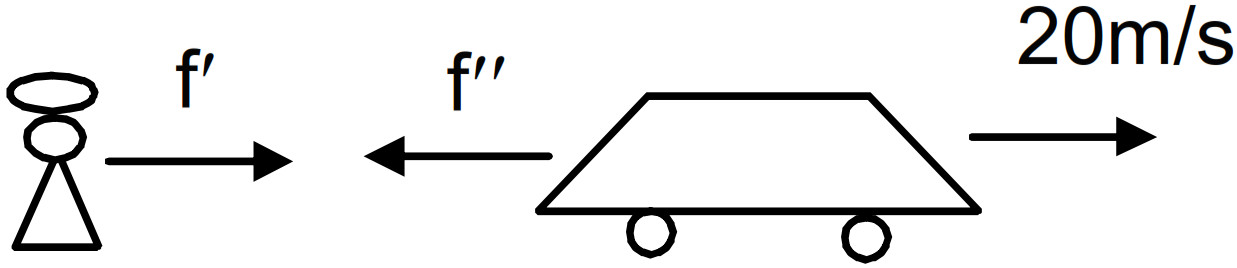 Here given, $\text{u}=330\text{m/s},\ \text{f}=1600\text{Hz}$