Question
Two coherent sources of light can be obtained by

Answer

(d)The coherent source cannot be obtained from two different light sources.

Need a full question paper?

Generate a complete, print-ready paper with questions like this in minutes — across 16+ boards, with answer keys.
Start Generating Free

Similar questions

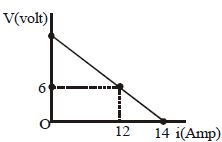
$10\,Cells$, each of emf $'E'$ and internal resistance $'r'$, are connected in series to a variable external resistance. Figure shows the variation of terminal potential difference of their combination with the current drawn from the combination.$Emf$ of each cell is ............. $V$
Young's modulus of a material has the same units as
At the highest point of the path of a projectile, its
A square loop of area $25\,cm ^2$ has a resistance of $10\,\Omega$. The loop is placed in uniform magnetic field of magnitude $40.0 T$. The plane of loop is perpendicular to the magnetic field. The work done in pulling the loop out of the magnetic field slowly and uniformly in $1.0 sec$, will be $..........\times 10^{-3}$
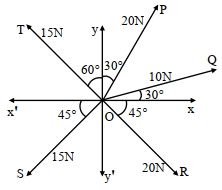
The resultant of these forces $\overrightarrow{O P}, \overrightarrow{O Q}, \overrightarrow{O R}, \overrightarrow{O S}$ and $\overrightarrow{{OT}}$ is approximately $\ldots \ldots {N}$.

[Take $\sqrt{3}=1.7, \sqrt{2}=1.4$ Given $\hat{{i}}$ and $\hat{{j}}$ unit vectors along ${x}, {y}$ axis $]$
The dimensions of thermal resistance are
Monochromatic light of wavelength $500 \mathrm{~nm}$ is used in Young's double slit experiment. An interference pattern is obtained on a screen When one of the slits is covered with a very thin glass plate (refractive index $=1.5$ ), the central maximum is shifted to a position previously occupied by the $4^{\text {th }}$ bright fringe. The thickness of the glass-plate is ......................
Radius of $_2H{e^4}$ nucleus is $3 \,Fermi.$ The radius of $_{82}P{b^{206}}$ nucleus will be..........$fermi$
If the string of a conical pendulum makes an angle $\theta$ with horizontal, then square of its time period is proportional to
If an electron in a hydrogen atom jumps from the $3^{rd}$ orbit to the $2^{nd}$ orbit, it emits a photon of wavelength $\lambda$. when it jumps from the $4^{th}$ orbit to the $3^{rd}$ orbit, the corresponding wavelength of the photon will be