Two concentric spheres $A$ and $B$ are kept very near to each other. $A$ is negatively charged and $B$ is earthed. The true statement is
$(A)$ Charge on $B$ is zero
$(B)$ Potential at $B$ is zero
$(C)$ Charge is uniformly distributed on $A$
$(D)$ Charge is non uniformly distributed on $A$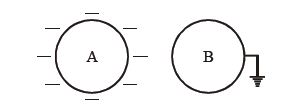
Medium
Download our app for free and get started
Potential at earthed conductor becomes zero and by induction charge will not remain uniform

Download our appand get started for free
Experience the future of education. Simply download our apps or reach out to us for more information. Let's shape the future of learning together!No signup needed.*
Similar Questions
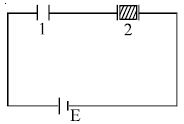
- 1Two identical capacitors $1$ and $2$ are connected in series to a battery as shown in figure. Capacitor $2$ contains a dielectric slab of dielectric constant k as shown. $Q_1$ and $Q_2$ are the charges stored in the capacitors. Now the dielectric slab is removed and the corresponding charges are $Q’_1$ and $Q’_2$. ThenView Solution
- 2A point charge $Q$ is placed in uniform electric field $\vec E = E_1 \hat i + E_2\hat j$ at position $(a, b)$. Find work done in moving it to position $(c, d)$View Solution
- 3Two charged conducting spheres of radii $a$ and $b$ are connected to each other by a conducting wire. The ratio of charges of the two spheres respectively is:View Solution
- 4After the switch shown in figure $A$ is closed, there is current $i$ through resistance $R$. Figure $B$ indicates current variation curves $a, b, c$ and $d$ for four sets of values of $R$ and capacitance $C$:View Solution
$(i)$ $R_0$ and $C_0$, $(ii)$ $2R_0$ and $C_0$,
$(iii)$ $R_0$ and $2C_0$, $(iv)$ $2R_0$ and $2C_0$.
Which set goes with which curve?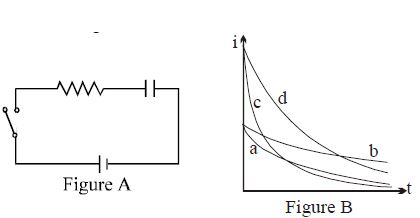
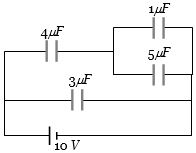
- 5The charge on $4\, \mu F$ capacitor in the given circuit is .... in $\mu C$View Solution
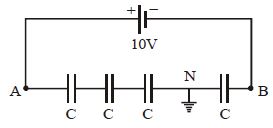
- 6Four identical capacitors are connected in series with a $10\,V$ battery as shown. The point $N$ is earthed. The potentials of points $A$ and $B$ areView Solution
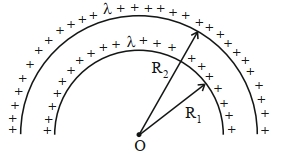
- 7The electric potential at the centre of two concentric half rings of radii $R_1$ and $R_2$, having same linear charge density $\lambda$ isView Solution
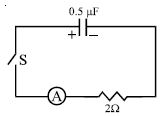
- 8A charged capacitor is allowed to discharge through a resistance $2\,\Omega $ by closing the switch $S $ at the instant $t = 0$. At time $t = ln$ $2$ $\mu s$, the reading of the ammeter falls half of its initial value. The resistance of the ammeter equal toView Solution
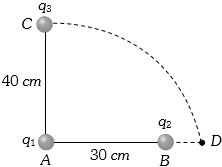
- 9Two charges ${q_1}$ and ${q_2}$ are placed $30\,\,cm$ apart, shown in the figure. A third charge ${q_3}$ is moved along the arc of a circle of radius $40\,cm$ from $C$ to $D$. The change in the potential energy of the system is $\frac{{{q_3}}}{{4\pi {\varepsilon _0}}}k$, where $k$ isView Solution
- 10Let $V$ and $E$ are potential and electric field intensity at a point thenView Solution