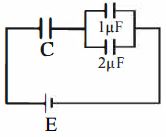
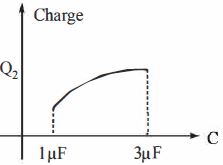
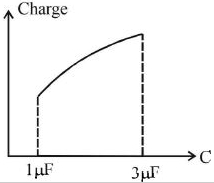
In the given circuit, charge $Q_2$ on the $2\ μF$ capacitor changes as $C$ is varied from $1\ μF$ to $3\ μF$. $Q_2$ as a function of '$C$' is given properly by: (figures are drawn schematically and are not to scale)
- A
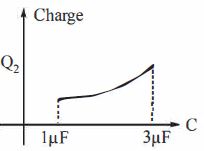
- B
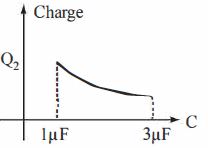
- C
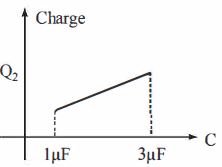
- D
JEE MAIN 2015, Diffcult


Download our appand get started for free
Experience the future of education. Simply download our apps or reach out to us for more information. Let's shape the future of learning together!No signup needed.*
Similar Questions
- 1The radius of a soap bubble whose potential is $16\,V$ is doubled. The new potential of the bubble will be.....$V$View Solution
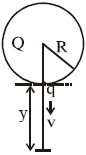
- 2A solid sphere of radius $R$ carries a charge $(Q+q)$ distributed uniformly over its volume. A very small point like piece of it of mass $m$ gets detached from the bottom of the sphere and falls down vertically under gravity. This piece carries charge $q.$ If it acquires a speed $v$ when it has fallen through a vertical height $y$ (see figure), then :View Solution
(assume the remaining portion to be spherical).
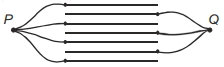
- 3Seven identical plates each of area $A$ and successive separation $d$ are arranged as shown in figures. The effective capacitance of the system between $P$ and $Q$ isView Solution
- 4View SolutionA capacitor is kept connected to the battery and a dielectric slab is inserted between the plates. During this process
- 5Two charged particles of masses $m$ and $2m$ have charges $+2q$ and $+q$ respectively. They are kept in uniform electric field and allowed to move for some time. The ratio of their kinetic energies will beView Solution
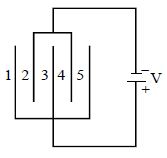
- 6Five similar condenser plates, each of area $A$, are placed at equal distance apart and are connected to a source of $e.m.f.$ $V$ as shown in the following diagram. The charge on the plates $1$ and $4$ will be:-View Solution
- 7View SolutionElectric potential of earth is taken to be zero because earth is a good
- 8If some charge is given to a solid metallic sphere, the field inside remains zero and by Gauss's law all the charge resides on the surface. Now, suppose that Coulomb's force between two charges varies as $1 / r^{3}$. Then, for a charged solid metallic sphereView Solution
- 9Two capacitances of capacity ${C_1}$ and ${C_2}$ are connected in series and potential difference $V$ is applied across it. Then the potential difference across ${C_1}$ will beView Solution
- 10There is an electric field $E$ in $X$-direction. If the work done on moving a charge $0.2\,C$ through a distance of $2\,m$ along a line making an angle $60^\circ $ with the $X$-axis is $4.0\;J$, what is the value of $E$........ $N/C$View Solution