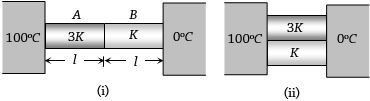
Two conducting rods $A$ and $B$ of same length and cross-sectional area are connected $(i)$ In series $(ii)$ In parallel as shown. In both combination a temperature difference of $100^o C$ is maintained. If thermal conductivity of $A$ is $3K$ and that of $B$ is $K$ then the ratio of heat current flowing in parallel combination to that flowing in series combination is
Medium
Download our app for free and get started
(a) Heat current $H = \frac{{\Delta \theta }}{R}$ ==> $\frac{{{H_P}}}{{{H_S}}} = \frac{{{R_S}}}{{{R_P}}}$
In first case : ${R_S} = {R_1} + {R_2} = \frac{l}{{(3K)A}} + \frac{l}{{KA}} = \frac{4}{3}\frac{l}{{KA}}$
In second case :${R_P} = \frac{{{R_1}{R_2}}}{{{R_1} + {R_2}}} = \frac{{\frac{l}{{(3K)A}} \times \frac{l}{{KA}}}}{{\left( {\frac{l}{{(3K)A}} + \frac{l}{{KA}}} \right)}} = \frac{l}{{4KA}}$
$\therefore \frac{{{H_P}}}{{{H_S}}} = \frac{{\frac{{4l}}{{3KA}}}}{{\frac{l}{{4KA}}}} = \frac{{16}}{3}$

Download our appand get started for free
Experience the future of education. Simply download our apps or reach out to us for more information. Let's shape the future of learning together!No signup needed.*
Similar Questions
- 1A hot black body emits the energy at the rate of $16\ J\ m^{-2}\ s^{-1}$ and its most intense radiation corresponds to $20,000\ Å$ . When the temperature of this body is further increased and its most intense radiation corresponds to $10,000\ Å$ , then the energy radiated in $Jm^{-2}\ s^{-1}$ will beView Solution
- 2Four spheres $A, B, C$ and $D$ are of same radius but made of different metals. Their densities are in ratio $6 : 3 : 4 : 5$ and specific heats are in ratio $2 : 5 : 4 : 6$ . These are initially kept at the same temperature and placed in the same surroundings. The sphere which has the slowest rate of cooling isView Solution
- 3A black body is heated from ${27^o}C$ to ${127^o}C$. The ratio of their energies of radiations emitted will beView Solution
- 4View SolutionFor cooking the food, which of the following type of utensil is most suitable
- 5Two rods of same material have same length and area. The heat $\Delta Q$ flows through them for $12\,minutes$ when they are jointed in series. If now both the rods are joined in parallel, then the same amount of heat $\Delta Q$ will flow in ........ $\min$View Solution
- 6A solid copper cube of edges $1\;cm$ is suspended in an evacuated enclosure. Its temperature is found to fall from ${100^o}C$ to ${99^o}C$ in $100\;s$. Another solid copper cube of edges $2\;cm$, with similar surface nature, is suspended in a similar manner. The time required for this cube to cool from ${100^o}C$ to ${99^o}C$ will be approximately ...... $\sec$View Solution
- 7If the temperature of the sun were to be increased from $T$ to $2T$ and its radius from $R$ to $2R$ , then the ratio of the radiant energy received on the earth to what it was previously will beView Solution
- 8A container with $1 kg$ of water in it is kept in sunlight, which causes the water to get warmer than the surroundings. The average energy per unit time per unit area received due to the sunlight is $700 Wm ^{-2}$ and it is absorbed by the water over an effective area of $0.05 m ^2$. Assuming that the heat loss from the water to the surroundings is governed by Newton's law of cooling, the difference (in ${ }^{\circ} C$ ) in the temperature of water and the surroundings after a long time will be. . . . . . . . (Ignore effect of the container, and take constant for Newton's law of cooling $=0.001 s ^{-1}$, Heat capacity of water $\left.=4200 J kg ^{-1} K ^{-1}\right)$View Solution
- 9A copper rod $2\,m$ long has a circular cross-section of radius $1\, cm$. One end is kept at $100^o\,C$ and the other at $0^o\,C$ and the surface is covered by nonconducting material to check the heat losses through the surface. The thermal resistance of the bar in degree kelvin per watt is (Take thermal conductivity $K = 401\, W/m-K$ of copper):-View Solution
- 10Two identical beakers $A$ and $B$ contain equal volumes of two different liquids at $60\,^oC$ each and left to cool down. Liquid in $A$ has density of $8 \times10^2\, kg / m^3$ and specific heat of $2000\, Jkg^{-1}\,K^{-1}$ while liquid in $B$ has density of $10^3\,kgm^{-3}$ and specific heat of $4000\,JKg^{-1}\,K^{-1}$ . Which of the following best describes their temperature versus time graph schematically? (assume the emissivity of both the beakers to be the same)View Solution