Two cubes of size $1.0$ $m$ sides, one of relative density $0.60$ and another of relative density $=$ $1.15$ are connected by weightless wire and placed in a large tank of water. Under equilibrium the lighter cube will project above the water surface to a height of ........ $cm$
Advanced
Download our app for free and get started
Given two cubes of $1 \mathrm{m}$ side each and relative density $0.60$ and $1.15$ respectively.
This means that one block is lighter than water and the other one heavier than water. So the lighter one $(Block\, A)$ floats on water and the heavier one$(Block \,B)$ sinks fully. So in equilibrium the arrangement will be somewhat similar to the one shown in figure.
since the system is in equilibrium there is no net fore on the system.
Therefore entire upward force is equal to the total downward fore.
Total upward force $=$ Buoyancy force on $\mathrm{A}\left(B_{a}\right)+$
Buoyancy force on $\mathrm{B}\left(B_{b}\right)$ Buoyancy force $=$ density of liquid in which the object is immersed $\times$ volume of liquid displacedltimes gravitational constant.
$B_{a}=\rho \times((1-x) m \times 1 m \times 1 m) \times g$
$B_{b}=\rho \times(1 m \times 1 m \times 1 m) \times g$
Total buoyancy force $=B_{a}+B_{b}$
$=\rho \times g \times((2-x) m) \times(1 m \times 1 m)$ $....(1)$
Total downward force $=$ Weight of $\mathrm{A}\left(W_{a}\right)+$ Weight of $\mathrm{B}\left(W_{b}\right)$ Weight $=$ density of the block $\times$ volume of the block Itimes gravitational constant.
$W_{a}=\rho(A) \times(1 m \times 1 m \times 1 m) \times g$
$W_{b}=\rho(B) \times(1 m \times 1 m \times 1 m) \times g .$ Total downward force $=W_{a}+W_{b}$
$=\rho(A) \times(1 m \times 1 m \times 1 m) \times g+\rho(B) \times(1 m \times 1 m \times 1 m) \times g$
$=\rho(A)+\rho(B) \times(1 m \times 1 m \times 1 m) \times g$
$=(0.60+1.15) \times(1 m \times 1 m \times 1 m) \times g$
$=1.75 \times(1 m \times 1 m \times 1 m) \times g$ $...(2)$
Equations $1$ and $2$ are equal
$\Rightarrow \rho \times g \times((2-x) m) \times(1 m \times 1 m)=1.75 \times(1 m \times 1 m \times 1 m) \times g$
$\Rightarrow 2-x=1.75 \text { (since } \rho=1 \text { for water })$
$\Rightarrow \quad x=0.25 m(\text { or }) 25 \mathrm{cm}$
Therefore under equilibrium the lighter cube will project above the water surface to a height of $25 \mathrm{cm} .$

Download our appand get started for free
Experience the future of education. Simply download our apps or reach out to us for more information. Let's shape the future of learning together!No signup needed.*
Similar Questions
- 1View SolutionGauge pressure ........
- 2A large vessel of height $H$, is filled with a liquid of density $\rho$, upto the brim. A small hole of radius $r$ is made at the side vertical face, close to the base. The horizontal force is required to stop the gushing of liquid is ...........View Solution
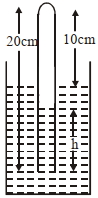
- 3A $20 \,cm$ long tube is closed at one end. It is held vertically, and its open end is dipped in water until only half of it is outside the water surface. Consequently, water rises in it by height $h$ as shown in the figure. The value of $h$ is closest to .............. $\,m / s$ (assume that the temperature remains constant, $P _{\text {armosphere }}=10^5 \,N / m ^2$, density. of water $=10^3 \,kg / m ^3$, and acceleration due to gravity $g =10 \,m / s ^2$ )View Solution
- 4A hot air balloon is carrying some passengers, and a few sandbags of mass $1 kg$ each so that its total mass is $480 kg$. Its effective volume giving the balloon its buoyancy is $V$. The balloon is floating at an equilibrium height of $100 m$. When $N$ number of sandbags are thrown out, the balloon rises to a new equilibrium height close to $150 m$ with its volume $V$ remaining unchanged. If the variation of the density of air with height $h$ from the ground is $\rho(h)=\rho_0 e^{-\frac{h}{h_0}}$, where $\rho_0=1.25 kg m ^{-3}$ and $h _0=6000 m$, the value of $N$ is. . . . .View Solution
- 5A sphere of solid material of relative density $9$ has a concentric spherical cavity and floats having just sinked in water. If the radius of the sphere be $R$, then the radius of the cavity $(r)$ will be related to $R$ as :-View Solution
- 6If two liquids of same masses but densities ${\rho _1}$ and ${\rho _2}$ respectively are mixed, then density of mixture is given byView Solution
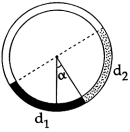
- 7There is a circular tube in a vertical plane. Two liquids which do not mix and of densities $d_1$ and $d_2$ are filled in the tube. Each liquid subtends $90^o$ angle at centre. Radius joining their interface makes an angle $\alpha$ with vertical. Ratio $\frac{{{d_1}}}{{{d_2}}}$ isView Solution
- 8The Bhagirathi and the Alaknanda merge at Deoprayag to form the Ganga with their speeds in the ratio $1: 1: 5$. The cross-sectional areas of the Bhagirathi, the Alaknanda and the Ganga are in the ratio $1: 2: 3$. Assuming streamline flow, the ratio of the speed of Ganga to that of the Alaknanda isView Solution
- 9The weight of a body in water is one third of its weight in air. The density of the body is ....... $g / cm ^3$View Solution
- 10The volume of an air bubble is doubled as it rises from the bottom of lake to its surface. The atmospheric pressure is $75 \,cm$ of mercury. The ratio of density of mercury to that of lake water is $\frac{40}{3}$. The depth of the lake in metre is .........View Solution