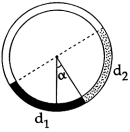
There is a circular tube in a vertical plane. Two liquids which do not mix and of densities $d_1$ and $d_2$ are filled in the tube. Each liquid subtends $90^o$ angle at centre. Radius joining their interface makes an angle $\alpha$ with vertical. Ratio $\frac{{{d_1}}}{{{d_2}}}$ is
JEE MAIN 2014, Diffcult
Download our app for free and get started
Equating pressure at $A$
$\left( {R\cos \alpha + R\sin \alpha } \right){d_2}g = \left( {R\cos \alpha - R\sin \alpha } \right){d_1}g$
$ \Rightarrow \frac{{{d_1}}}{{{d_2}}} = \frac{{\cos \alpha + \sin \alpha }}{{\cos \alpha - \sin \alpha }} = \frac{{1 + \tan \alpha }}{{1 - \tan \alpha }}$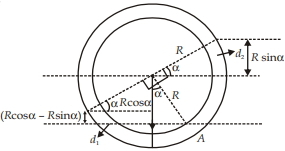

Download our appand get started for free
Experience the future of education. Simply download our apps or reach out to us for more information. Let's shape the future of learning together!No signup needed.*
Similar Questions
- 1The cylindrical tube of a spray pump has radius $R,$ one end of which has $n$ fine holes, each of radius $r.$ If the speed of the liquid in the tube is $v,$ the speed of the ejection of the liquid through the holes isView Solution
- 2A cubical block of side $'a'$ and density $'\rho '$ slides over a fixed inclined plane with constant velocity $'v'$ . There is a thin film of viscous fluid of thickness $'t'$ between the plane and the block. Then the coefficient of viscosity of the thin film will beView Solution

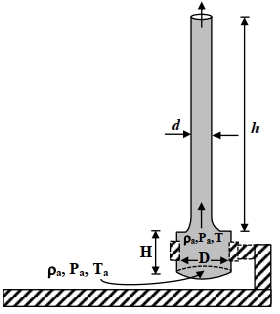
- 3A cylindrical furnace has height $(H)$ and diameter $(D)$ both $1 \mathrm{~m}$. It is maintained at temperature $360 \mathrm{~K}$. The air gets heated inside the furnace at constant pressure $P_a$ and its temperature becomes $T=360 \mathrm{~K}$. The hot air with density $\rho$ rises up a vertical chimney of diameter $d=0.1 \mathrm{~m}$ and height $h=9 \mathrm{~m}$ above the furnace and exits the chimney (see the figure). As a result, atmospheric air of density $\rho_a=1.2 \mathrm{~kg} \mathrm{~m}^{-3}$, pressure $P_a$ and temperature $T_a=300 \mathrm{~K}$ enters the furnace. Assume air as an ideal gas, neglect the variations in $\rho$ and $T$ inside the chimney and the furnace. Also ignore the viscous effects.View Solution
[Given: The acceleration due to gravity $g=10 \mathrm{~ms}^{-2}$ and $\pi=3.14$ ]
(image)
($1$) Considering the air flow to be streamline, the steady mass flow rate of air exiting the chimney is
. . . . .$\mathrm{gm} \mathrm{s}^{-1}$.
($2$) When the chimney is closed using a cap at the top, a pressure difference $\Delta P$ develops between the top and the bottom surfaces of the cap. If the changes in the temperature and density of the hot air, due to the stoppage of air flow, are negligible then the value of $\Delta P$ is. . . . .$\mathrm{Nm}^{-2}$.
- 4A large vessel of height $H$, is filled with a liquid of density $\rho$, upto the brim. A small hole of radius $r$ is made at the side vertical face, close to the base. The horizontal force is required to stop the gushing of liquid is ...........View Solution
- 5View SolutionThe coefficient of viscosity for hot air is
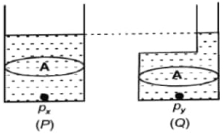
- 6Figure shows two containers $P$ and $Q$ with same base area $A$ and each filled upto same height with same liquid. Select the correct alternative .............View Solution
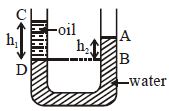
- 7In a $U-$ tube experiment, a column $AB$ of water is balanced by a column $‘CD’$ of oil, as shown in the figure. Then the relative density of oil isView Solution
- 8An empty balloon weighs $1\, g$. The balloon is filled with water to the neck and tied with a massless thread. The weight of balloon alongwith water is $101\, g$. The balloon filled with water is weighed when fully immersed. Then, its weight in water is ...... $g$View Solution
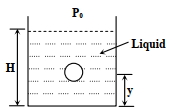
- 9A small spherical monoatomic ideal gas bubble $\left(\gamma=\frac{5}{3}\right)$ is trapped inside a liquid of density $\rho_{\ell}$ (see figure). Assume that the bubble does not exchange any heat with the liquid. The bubble contains n moles of gas. The temperature of the gas when the bubble is at the bottom is $\mathrm{T}_0$, the height of the liquid is $\mathrm{H}$ and the atmospheric pressure is $\mathrm{P}_0$ (Neglect surface tension).View Solution
Figure: $Image$
$1.$ As the bubble moves upwards, besides the buoyancy force the following forces are acting on it
$(A)$ Only the force of gravity
$(B)$ The force due to gravity and the force due to the pressure of the liquid
$(C)$ The force due to gravity, the force due to the pressure of the liquid and the force due to viscosity of the liquid
$(D)$ The force due to gravity and the force due to viscosity of the liquid
$2.$ When the gas bubble is at a height $\mathrm{y}$ from the bottom, its temperature is
$(A)$ $\mathrm{T}_0\left(\frac{\mathrm{P}_0+\rho_0 \mathrm{gH}}{\mathrm{P}_0+\rho_t \mathrm{gy}}\right)^{2 / 5}$
$(B)$ $T_0\left(\frac{P_0+\rho_t g(H-y)}{P_0+\rho_t g H}\right)^{2 / 5}$
$(C)$ $\mathrm{T}_0\left(\frac{\mathrm{P}_0+\rho_t \mathrm{gH}}{\mathrm{P}_0+\rho_t \mathrm{gy}}\right)^{3 / 5}$
$(D)$ $T_0\left(\frac{P_0+\rho_t g(H-y)}{P_0+\rho_t g H}\right)^{3 / 5}$
$3.$ The buoyancy force acting on the gas bubble is (Assume $R$ is the universal gas constant)
$(A)$ $\rho_t \mathrm{nRgT}_0 \frac{\left(\mathrm{P}_0+\rho_t \mathrm{gH}\right)^{2 / 5}}{\left(\mathrm{P}_0+\rho_t \mathrm{gy}\right)^{7 / 5}}$
$(B)$ $\frac{\rho_{\ell} \mathrm{nRgT}_0}{\left(\mathrm{P}_0+\rho_{\ell} \mathrm{gH}\right)^{2 / 5}\left[\mathrm{P}_0+\rho_{\ell} \mathrm{g}(\mathrm{H}-\mathrm{y})\right]^{3 / 5}}$
$(C)$ $\rho_t \mathrm{nRgT} \frac{\left(\mathrm{P}_0+\rho_t g \mathrm{H}\right)^{3 / 5}}{\left(\mathrm{P}_0+\rho_t g \mathrm{~g}\right)^{8 / 5}}$
$(D)$ $\frac{\rho_{\ell} \mathrm{nRgT}_0}{\left(\mathrm{P}_0+\rho_{\ell} \mathrm{gH}\right)^{3 / 5}\left[\mathrm{P}_0+\rho_t \mathrm{~g}(\mathrm{H}-\mathrm{y})\right]^{2 / 5}}$
Give the answer question $1,2,$ and $3.$
- 10A fire hydrant delivers water of density $\rho $ at a volume rate $L$. The water travels vertically upward through the hydrant and then does $90^o$ turn to emerge horizontally at speed $V$. The pipe and nozzle have uniform cross-section throughout. The force exerted by the water on the corner of the hydrant isView Solution