Question
Two discharge tubes have identical material structures and the same gas is filled in them. The length of one tube is 10cm and that of the other tube is 20cm. Sparking starts in both the tubes when the potential difference between the cathode and the anode is 100V. If the pressure in the shorter tube is 1.0mm of mercury, what is the pressure in the longer tube?
Answer

$\text{V}=\text{f(Pd)}$$\text{V}_\text{s}=\text{P}_\text{s}\text{d}_\text{s}$
$\text{V}_\text{L}=\text{P}_\text{L}\text{d}_\text{L}$
$\Rightarrow\frac{\text{V}_\text{s}}{\text{V}_\text{L}}=\frac{\text{P}_\text{s}}{\text{P}_\text{L}}\times\frac{\text{d}_\text{s}}{\text{d}_\text{L}}$
$\Rightarrow\frac{100}{100}=\frac{10}{20}\times\frac{1\text{mm}}{\text{x}}$
$\Rightarrow\text{x}=\frac{1\text{mm}}{2}=0.5\text{mm}$

Need a full question paper?

Generate a complete, print-ready paper with questions like this in minutes — across 16+ boards, with answer keys.

Start Generating Free

Similar questions

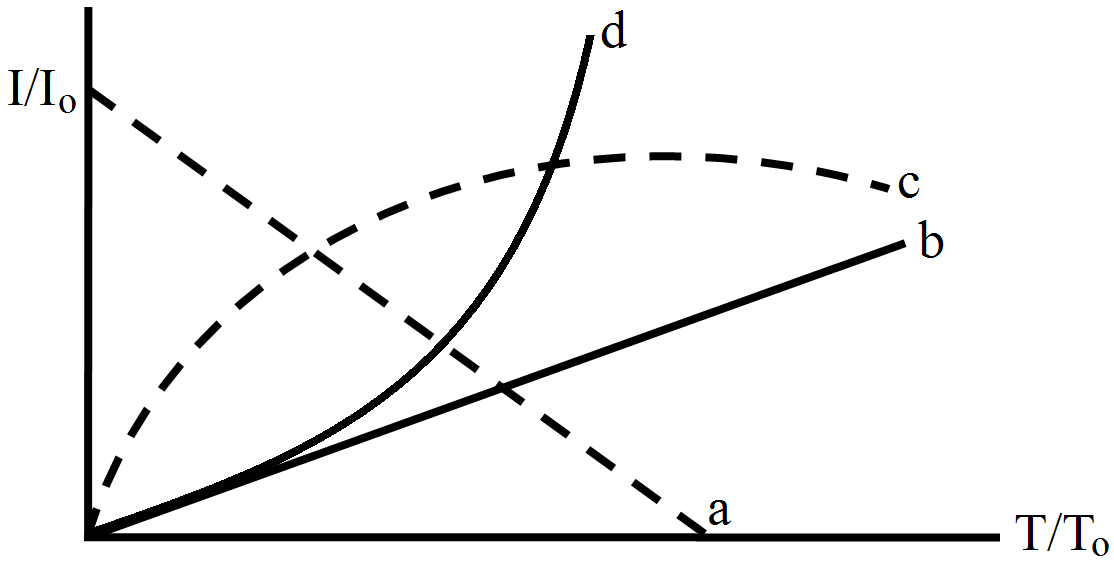
Let $\text{i}_0$ be the thermionic current from a metal surface when the absolute temperature of the surface is $\text{T}_0$. The temperature is slowly increased and the thermionic current is measured as a function of temperature. Which of the following plots may represent the variation in $\Big(\frac{\text{i}}{\text{i}_0}\Big)$ against $\Big(\frac{\text{T}}{\text{T}_0}\Big)?$
A person goes to bed at sharp 10:00 pm every day. Is it an example of periodic motion? If yes, what is the time period? If no, why?
A lady cannot see objects closer than 40cm from the left eye and closer than 100cm from the right eye. While on a mountaineering trip, she is lost from her team. She tries to make an astronomical telscope from her reading glasses to look for her teammates.
  1. Which glass should she use as the eyepiece?
  2. What magnification can she get with relaxed eye?
The electron beam in a colour TV is accelerated through 32kV and then strikes the screen. What is the wavelength of the most energetic X-ray photon?
Read the passage given below and answer the following questions from i to v. If an object moving along the straight line covers equal distances in equal intervals of time, it is said to be in uniform motion along a straight line. Distance and displacement are two quantities that seem to mean the same but are different with different meanings and definitions. Distance is the measure of actual path length travelled by object. It is scalar quantity having SI unit of metre while displacement refers to the shortest distance between initial and final position of object. It is vector quantity. The magnitude of the displacement for a course of motion may be zero but the corresponding path length is not zero. using this data answer following questions.
  1. Can path length be zero for motion of body from one point to other point?
  1. Yes
  2. No
  1. For any given motion from point A to B, displacement =10m and distance = 5m. Is it possible?
  1. Yes
  2. No
  1. For rectilinear motion displacement can be
  1. Positive only
  2. Negative only
  3. Can be zero
  4. All of the above
  1. Define distance and displacement of particle.
  1. Write difference between distance and displacement.
An ideal gas is pumped into a rigid container having diathermic walls so that the temperature remains constant. In a certain time interval, the pressure in the container is doubled. Is the internal energy of the contents of the container also doubled in the interval?
Read the passage given below and answer the following questions from $1$ to $5.$ Friction: Let us return to the example of a body of mass m at rest on a horizontal table. The force of gravity $(mg)$ is cancelled by the normal reaction force $(N)$ of the table. Now suppose a force F is applied horizontally to the body. We know from experience that a small applied force may not be enough to move the body. But if the applied force F were the only external force on the body, it must move with acceleration F/m, however small. Clearly, the body remains at rest because some other force comes into play in the horizontal direction and opposes the applied force F, resulting in zero net force on the body. This force fs parallel to the surface of the body in contact with the table is known as frictional force, or simply friction. When there is no applied force, there is no static friction. It comes into play the moment there is an applied force. As the applied force $F$ increases, fs also increases, remaining equal and opposite to the applied force $($up to a certain limit$),$ keeping the body at rest. Hence, it is called static friction. Static friction opposes impending motion. The term impending motion means motion that would take place $($but does not actually take place$)$ under the applied force, if friction were absent. It is found experimentally that the limiting value of static friction $(fs )$ max f is independent of the area of contact and varies with the normal force$(N)$ approximately as: $(\text{f}_{\text{s}})\text{max}=\mu\text{N}$ where μs is a constant of proportionality depending only on the nature of the surfaces in contact. The constant μs is called the coefficient of static friction. The law of static friction may thus be written as $(\text{f}_{\text{s}})\leq\mu\text{sN}$ Frictional force that opposes relative motion between surfaces in contact is called kinetic or sliding friction and is denoted by $fk$. Kinetic friction, like static friction, is found to be independent of the area of contact. Further, it is nearly independent of the velocity. It satisfies a law similar to that for static friction: $(\text{f}_{\text{k}})=\mu_{\text{k}}\text{N}$
  1. Force of static friction is directly proportional to:
  1. Normal reaction
  2. Force by gravity
  3. Velocity of body
  4. None of these
  1. Coefficient of kinetic friction is independent of area of contact. True or false?
  1. True
  2. False
  1. Give formula for law of static friction
  1. Explain law of static friction
  1. Explain kinetic friction.
Read the passage given below and answer the following questions from 1 to 5.Following are properties of vectors
a) Two vectors A and B are said to be equal if, and only if, they have the same magnitude and the same direction.
b) Multiplying a vector A with a positive number λ gives a vector whose magnitude is changed by the factor λ but the direction is the same as that of A:
$|\ \lambda\text{ A }|=\lambda\text{ A }|$
c) The null vector also results when we multiply a vector A by the number zero. Properties of 0 are
A + 0 = A
λ 0 = 0
0 A = 0
d) Subtraction of vectors can be defined in terms of addition of vectors. We define the difference of two vectors A and B as the sum of two vectors A and –B :
A – B = A + (–B).
  1. Two vectors A and B are said to be equal if:
  1. they have the same magnitude
  2. they have the same direction
  3. they have the same magnitude and the same direction
  4. None of these
  1. Multiplying a vector A with a positive number will impact:
  1. Change in magnitude
  2. Change in direction
  3. Change in both magnitude and the same direction
  4. None of these
  1. What is null vector?
  1. How we can perform subtraction of two vectors?
  1. Enlist any 4 properties of vectors.
A fat person is standing on a light plank floating on a calm lake. The person walks from one end to the other on the plank. His friend sitting on the shore watches him and finds that the person hardly moves any distance because the plank moves backward about the same distance as the person moves on the plank. Explain.