Question
Two discharge tubes have identical material structures and the same gas is filled in them. The length of one tube is 10cm and that of the other tube is 20cm. Sparking starts in both the tubes when the potential difference between the cathode and the anode is 100V. If the pressure in the shorter tube is 1.0mm of mercury, what is the pressure in the longer tube?
Answer

$\text{V}=\text{f(Pd)}$

$\text{V}_\text{s}=\text{P}_\text{s}\text{d}_\text{s}$

$\text{V}_\text{L}=\text{P}_\text{L}\text{d}_\text{L}$

$\Rightarrow\frac{\text{V}_\text{s}}{\text{V}_\text{L}}=\frac{\text{P}_\text{s}}{\text{P}_\text{L}}\times\frac{\text{d}_\text{s}}{\text{d}_\text{L}}$

$\Rightarrow\frac{100}{100}=\frac{10}{20}\times\frac{1\text{mm}}{\text{x}}$

$\Rightarrow\text{x}=\frac{1\text{mm}}{2}=0.5\text{mm}$

Need a full question paper?

Generate a complete, print-ready paper with questions like this in minutes — across 16+ boards, with answer keys.

Start Generating Free

Similar questions

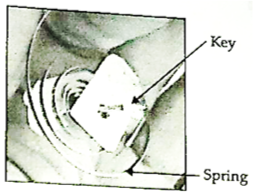
Clockwork refers to the inner workings of mechanical clock or watch (where it is known as "movement") and different types of toys which work using a series of gears driven by a spring. Clockwork device is completely mechanical and its essential parts are:
- A key (or crown) which you wind to add energy
- A spiral spring in which the energy is stored
- A set of gears through which the spring's energy is released. The gears control how quickly (or slowly) a clockwork machine can do things. Such as in mechanical clock/watch the mechanism is the set of hands that sweep around the dial to tell the time. In a clockwork car toy, the gears drive the wheels.
Winding the clockwork with the key means tightening a sturdy metal spring, called the mainspring. It is the process of storing potential energy. Clockwork springs are usually twists of thick steel, so tightening them (forcing the spring to occupy a much smaller space) is actually quite hard work. With each turn of the key, fingers do work and potential energy is stored in the spring. The amount of energy stored depends on the size and tension of the spring. Harder a spring is to turn and longer it is wound, the more energy it stores.
Image

While the spring uncoils, the potential energy is converted into kinetic energy through gears, cams, cranks and shafts which allow wheels to move faster or slower. In an ancient clock, gears transform the speed of a rotating shaft so that it drives the second hand at one speed, the minute hand at $\frac{1}{60}$ of that speed, and the hour hand at $\frac{1}{3600}$ of that speed. Clockwork toy cars often use gears to make themselves race along at surprising speed.

1. What is the meaning of movement of old age mechanical clocks?
(a) The pendulum of the clock
(b) The gears which move the hands of the clock
(c) A spring and combination of gears which move the hands of the clock
(d) The hands of the clock
2. What type of energy is stored in the spring while winding it?
(a) Potential  (b) Heat  (c) Both kinetic and potential  (d) Kinetic
3. When the spring of a clockwork uncoils
(a) Kinetic energy is converted into potential energy
(b) Potential energy is converted into kinetic
(c) Potential energy is converted into heat, light and sound energy
(d) Kinetic energy is converted into heat, light and sound energy
OR
More energy is stored in a spring if the
(a) Spring is larger, harder and wound fur a longer time
(b) Spring is smaller, harder and wound for a shorter time
(c) Spring is larger, harder and wound for a shurter time
(d) Spring is larger, softer and wound for a shorter time
4. In clockwork devices, ____________ transform the speed of a rotating ____________ to drive wheels slower or faster.
(a) Shaft, spring  (b) shaft, gear  (c) Gear, Shaft  (d) Spring, gear
In an experiment on the specific heat of a metal, a 0.20 kg block of the metal at $150^{\circ} C$ is dropped in a copper calorimeter (of water equivalent 0.025 kg ) containing $150 cm^3$. of water at $27^{\circ} C$. The final temperature is $40^{\circ} C$. Compute the specific heat of the metal. If heat losses to the surroundings are not negligible, is your answer greater or smaller than the actual value for specific heat of the metal?
A ladder is resting with one end on a vertical wall and the other end on a horizontal floor. Is it more likely to slip when a man stands near the bottom or near the top?
Read the passage given below and answer the following questions from 1 to 5.

Rolling Motion
The rolling motion can be regarded as the combination of pure rotation and pure translation. It is also one of the most common motions observed in daily life.

Suppose the rolling motion (without slipping) of a circular disc on a level surface. At any instant, the point of contact P0 of the disc with the surface is at rest (as there is no slipping). If v CM is the velocity of centre of mass which is the geometric centre C of the disc, then the translational velocity of disc is v CM , which is parallel to the level surface. Velocity of centre of mass, $\text{V}_\text{cm}=\text{R}\omega$

  1. A solid cylinder is sliding on a smooth horizontal surface with velocity v0 without rotation. It enters on the rough surface. After that it has travelled some distance, the friction force increases its:
  1. translational kinetic energy
  2. rotational kinetic energy
  3. total mechanical energy
  4. angular momentum about an axis passing through point of contact of the cylinder and the surface
  1. A cylinder rolls down an inclined plane of inclination 30°, the acceleration of cylinder is:
  1. $\frac{\text{g}}{3}$
  2. g
  3. $\frac{\text{g}}{2}$
  4. $\frac{2g}{3}$
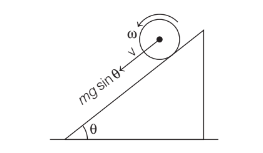
  1. Sphere is in pure accelerated rolling motion in the figure shown:

Choose the correct option.

  1. The direction of fs is upwards
  2. The direction of fs is downwards
  3. The direction of gravitational force is upwards
  4. The direction of normal reaction is downwards
  1. Kinetic energy of a rolling body will be:
  1. $\frac{1}{2}\text{mv}^2_\text{ cm}(\text{l}+\frac{\text{k}^2}{\text{R}^2}\big)$
  2. $\frac{1}{2}\text{I}\infty^2$
  3. $\frac{1}{2}\text{mv}^2\text{cm}$
  4. (d) None of the above
  1. A body is rolling down an inclined plane. Its translational and rotational kinetic energies are equal. The body is a:
  1. solid sphere
  2. hollow sphere
  3. solid cylinder
  4. hollow cylinder
In the HCl molecule, the separation between the nuclei of the two atoms is about 1.27 Å $\left(1 Å=10^{-10} m\right)$. Find the approximate location of the CM of the molecule, given that a chlorine atom is about 35.5 times as massive as a hydrogen atom and nearly all the mass of an atom is concentrated in its nucleus.
A police jeep is chasing a culprit going on a motorbike. The motorbike crosses a turning at a speed of 72km/h. The jeep follows it at a speed of 90km/h, crossing the turning ten seconds later than the bike. Assuming that they travel at constant speeds, how far from the turning will the jeep catch up with the bike?
Would you prefer a material with a high melting point or a low melting point to be used as a cathode in a diode?
A molecule of a gas, filled in a. discharge tube, gets ionized when an electron is detacbed from it. An electric field of 5.0kV/m exists in the vicinity of the event. (a) Find the distance travelled by the free electron in $1\mu\text{s}$ assuming no collision. (b) If the mean free path of the electron is 1.0mm, estimate the time of transit of the free electron between successive collisions.
A batsman deflects a ball by an angle of 45º without chainging its initial speed which is equal to 54 km/h. What is the impulse imparted to the ball? (Mass of the ball is 0.15 kg.)
Read the passage given below and answer the following questions from 1 to 5. First Law of Thermodynamics The first law of thermodynamics is the general law of conservation of energy applied to any system in which energy transfer from or to the surroundings (through heat and work) is taken into account. It states that the energy supplied to the system goes in partly to increase the internal energy of the system and the rest in work on the environment. Mathematically, $\triangle\text{Q}=\triangle\text{U}+\triangle\text{W}$ where $\triangle\text{Q}$ is the heat supplied to the system, $\triangle\text{W}$ is the work done by the system and $\triangle\text{U}$ is the change in internal energy of the system. $\triangle\text{Q}$ and $\triangle\text{W}$ depend on the path taken to go from initial to final states, but the combination $\triangle\text{Q}​​-​​\triangle\text{W}$ is path independent.

  1. The first law of thermodynamics is concerned with conservation of:
  1. Number of molecules
  2. Number of moles
  3. Energy
  4. Temperature
  1. Which of the following is not a path function?
  1. $\triangle\text{Q}$

  2. $\triangle\text{Q}​​+\triangle\text{W}$

  3. $\triangle\text{W}$

  4. $\triangle\text{Q}​​-​​\triangle\text{W}$

  1. An electric heater supplies heat to a system at a rate of 120W. If system performs work at a rate of 80 J s-1, the rate of increase in internal energy is:
  1. 30 J s-1
  2. 40 J s-1
  3. 50 J s-1
  4. 60 J s-1
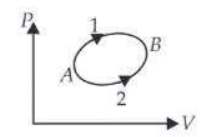
  1. Asystem goes from A to B by two different paths in the P - V diagram as shown in figure. Heat given to the system in path 1 is 1100 J, the work done by the system along path 1 is more than path 2 by 150 J. The heat exchanged by the system in path 2 is:

  1. 800 J
  2. 750 J
  3. 1050 J
  4. 950 J
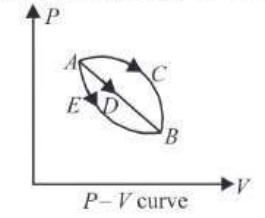
  1. A certain mass of gas is carried from A to B, along three paths via ACB, ADB and AEB. Which one of the following is correct?

  1. Work done via path ACB is minimum.
  2. Work done via path ADB is maximum.
  3. Work done via path ACB is maximum.
  4. Work done via path AEB is maximum.