MCQ
Two droplets merge with each other and forms a large droplet. In this process
  • Energy is liberated
  • B
    Energy is absorbed
  • C
    Neither liberated nor absorbed
  • D
    Some mass is converted into energy

Answer

Correct option: A.
Energy is liberated
(a) When two droplets merge with each other, their surface energy decreases.$W=T(\Delta A)=($ negative) i.e. energy is released.

Need a full question paper?

Generate a complete, print-ready paper with questions like this in minutes — across 16+ boards, with answer keys.
Start Generating Free

Similar questions

An ice cream has a marked value of $700 \mathrm{kcal}$. How many kilowatthour of energy will it deliver to the body as it is digested
An observer moves towards a stationary source of sound with a speed $1 / 5$ of the speed of sound. The wavelength and frequency of the source emitted are $\lambda$ and $f$ respectively. The apparent frequency and wavelength recorded by the observer are respectively
A body is revolving with a constant speed along a circle. If its direction of motion is reversed but the speed remains the same, then which of the following statement is true
Two stars situated at distances of $1$ and $10$ light years respectively from the earth appear to possess the same brightness. The ratio of their real brightness is
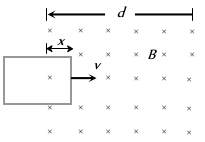
A rectangular loop is being pulled at a constant speed $v$, through a region of certain thickness $d$, in which a uniform magnetic field $B$ is set up. The graph between position $x$ of the right hand edge of the loop and the induced emf $E$ will beImage
The orbital velocity of a planet revolving close to earth's surface is
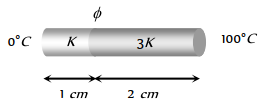
Two bars of thermal conductivities $K$ and $3 K$ and lengths $1 \mathrm{~cm}$ and $2 \mathrm{~cm}$ respectively have equal cross-sectional area, they are joined lengths wise as shown in the figure. If the temperature at the ends of this composite bar is $0^{\circ} \mathrm{C}$ and $100^{\circ} \mathrm{C}$ respectively (see figure), then the temperature $\phi$ of the interface isImage
A particle of mass $m$ moving with velocity $v$ strikes a stationary particle of mass $2 \mathrm{~m}$ and sticks to it. The speed of the system will be
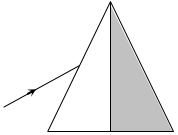
A light ray is incident upon a prism in minimum deviation position and suffers a deviation of $34^{\circ}$. If the shaded half of the prism is knocked off, the ray will
Image
Which of the following is quantised according to Bohr's theory of hydrogen atom