Two electric bulbs ($60\,W$ and $100\,W$ respectively) are connected in series. The current passing through them is
Easy


Download our appand get started for free
Experience the future of education. Simply download our apps or reach out to us for more information. Let's shape the future of learning together!No signup needed.*
Similar Questions
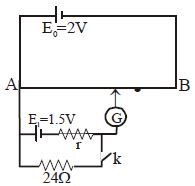
- 1For the arrangement of the potentiometer shown in the figure, the balance point is obtained at $a$ distance $75\,cm $ from $A$ when the key $k$ is open. The second balance point is obtained at $60\, cm$ from $A$ when the key $k$ is closed. Find the internal resistance (in $ \Omega$) of the battery $E_1$.View Solution
- 2View SolutionResistance of one carbon filament and one tungsten lamp are measured individually when the lamp are lit and compared with their respective resistances when cold. Which one of the following statements will be true
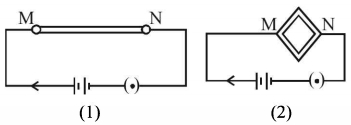
- 3A wire is connected to a battery between the point $M$ and $N$ as shown in the figure $(1)$. The same wire is bent in the form of a square and then connected to the battery between the points $M$ and $N$ as shown in the figure $(2)$. Which of the following quantities increases?View Solution
- 4The charge of an electron is $1.6 × 10^{-19}\,C$. How many electrons strike the screen of a cathode ray tube each second when the beam current is $16\,mA$View Solution
- 5An electric fan and a heater are marked as $100\, watt$, $220\, volt$ and $1000\, watt$, $220\, volt$ respectively. The resistance of the heater isView Solution
- 6View SolutionWatt-hour meter measures
- 7With a potentiometer null point were obtained at $140\, cm$ and $180\, cm$ with cells of $emf$ $1.1 \,V$ and one unknown $X\, volts$. Unknown $emf$ is .............. $V$View Solution
- 8Two resistances ${R_1}$ and ${R_2}$ are made of different materials. The temperature coefficient of the material of ${R_1}$ is $\alpha $ and of the material of ${R_2}$ is $ - \beta $. The resistance of the series combination of ${R_1}$ and ${R_2}$ will not change with temperature, if ${R_1}/{R_2}$ equalsView Solution
- 9When a potential difference $V$ is applied across a wire of resistance $R$, it dissipates energy at a rate $W$. If the wire is cut into two halves and these halves are connected mutually parallel across the same supply, the same supply, the energy dissipation rate will become:View Solution
- 10It takes $12$ minutes to boil $1$ litre of water in an electric kettle. Due to some defect it becomes necessary to remove $20 \%$ turns of heating coil of the kettle. After repair, how much time will it take to boil $1$ litre of water.View Solution