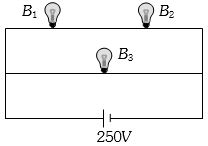
Two electric bulbs $A$ and $B$ are rated as $60\, W$ and $100\, W$. They are connected in parallel to the same source. Then,
Easy
Download our app for free and get started
(c) $i \propto \frac{1}{R}$ and $P \propto \frac{1}{R}$ $ \Rightarrow $ $i \propto P$
i.e. in parallel bulb of higher power will draw more current.

Download our appand get started for free
Experience the future of education. Simply download our apps or reach out to us for more information. Let's shape the future of learning together!No signup needed.*
Similar Questions
- 1The resistance of a wire of iron is $10\, ohms$ and temp. coefficient of resistivity is $5 \times {10^{ - 3}}\,^oC$. At $20\,^oC$ it carries $30$ milliamperes of current. Keeping constant potential difference between its ends, the temperature of the wire is raised to $120\,^oC$. The current in milliamperes that flows in the wire isView Solution
- 2In a meter bridge experiment null point is obtained at $20\, cm$ from one end of the wire when resistance $X$ is balanced against another resistance $Y$. If $X < Y$, then where will be the new position of the null point from the same end, if one decides to balance a resistance of $4X$ against $Y$ ........... $cm$View Solution
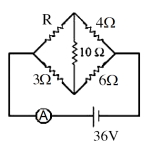
- 3Current measured by the ammeter $(A)$ in the reported circuit when no current flows through $10\,\Omega$ resistance. will be________$A$View Solution
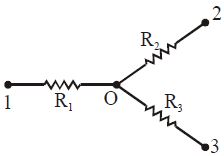
- 4.............. $A$ the current flowing through the resistance $R_2$ of the circuit shown in fig if the resistance are equal to $R_1 = 20\ \Omega, R_2 = 30 \ \Omega$ and $R_3 = 60 \ \Omega$ and potentials of points $1, 2$ and $3$ are equal to $V_1= 20\, V,$ $V_2 = 30\ V$ and $V_3 = 60\ V$View Solution
- 5The length of a given cylindrical wire is increased to double of its original length. The percentage increase in the resistance of the wire will be..... $\%$.View Solution
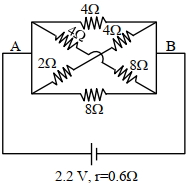
- 6In the given figure, the $emf$ of the cell is $2.2\, {V}$ and if internal resistance is $0.6\, \Omega$. Calculate the power dissipated in the whole circuit: (in $W$)View Solution
- 7A current through a wire depends on time as $i =\alpha_{0} t +\beta t ^{2}$ where $\alpha_{0}=20 A / s$ and $\beta=8 As ^{-2} .$ Find the charge crossed through a section of the wire in $15 \,s$ (in $C$)View Solution
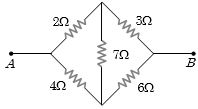
- 8Five resistances are connected as shown in the figure. The effective resistance between the points $A$ and $B$ isView Solution
- 9Two identical cells send the same current in $2\,\Omega $ resistance, whether connected in series or in parallel. The internal resistance of the cell should be ............... $\Omega$View Solution
- 10A $100\, W$ bulb $B_1$, and two $60\,W$ bulbs $B_2$ and $B_3$, are connected to a $250\, V$ source, as shown in the figure. Now $ W_1, W_2$ and $W_3$ are the output powers of the bulbs $B_1, B_2$ and $B_3$, respectively. ThenView Solution