Two electric bulbs $A$ and $B$ are rated as $60\, W$ and $100\, W$. They are connected in parallel to the same source. Then,
Easy


Download our appand get started for free
Experience the future of education. Simply download our apps or reach out to us for more information. Let's shape the future of learning together!No signup needed.*
Similar Questions
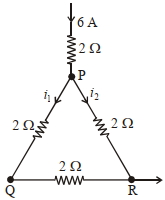
- 1A current of $6\, A$ enters one corner $P$ of an equilateral triangle $PQR$ having $3$ wires of resistance $2 \,\Omega$ each and leaves by the corner $R$. The currents $i_{1}$ in ampere is ........ .View Solution
- 2Electric bulb $50\, W$ - $100\, V$ glowing at full power are to be used in parallel with battery $120\, V$, $10 \,\Omega$. Maximum number of bulbs that can be connected so that they glow in full power isView Solution
- 3The charge flowing through a resistor $R$ varies with time $t$ as $Q = 3t -6t^2.$ The heat produced in $R$ till the current in it becomes zero isView Solution
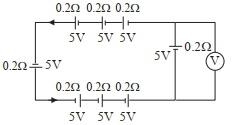
- 4The reading in the ideal voltmeter $(V)$ shown in the given circuit diagram is :View Solution
- 5The resistance of the filament of an electric bulb changes with temperature. If an electric bulb rated $220\, volt$ and $100\, watt$ is connected $(220 \times 0.8)$ $volt$ sources, then the actual power would beView Solution
- 6The resistance of the filament of a lamp increases with the increase in temperature. A lamp rated $100\, W, 220\, V$ is connected across $220\, V$ power supply. If the voltage drops by $10\%$ then the power of lamp will beView Solution
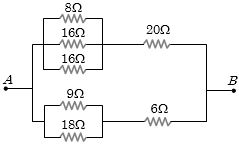
- 7The equivalent resistance of the arrangement of resistances shown in adjoining figure between the points $A$ and $B$ is ............... $ohm$View Solution
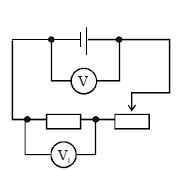
- 8If the rheostat slider were to move from the extreme right to the far left, How will the reading of voltmeter $V_1$ change?View Solution
- 9In Wheatstone's bridge $P = 9\, ohm$, $Q = 11\, ohm$, $R = 4\,ohm$ and $S = 6\,ohm$. How much resistance must be put in parallel to the resistance $S$ to balance the bridge ............... $ohm$View Solution
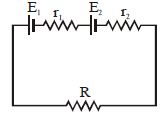
- 10Under what conditions current passing through a resistance $R$ can be increased by short circuiting the battery of emf $E_2$. The internal resistances of the two batteries are $r_1$ and $r_2$ respectivelyView Solution