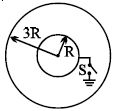
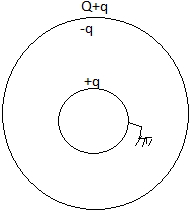
Two thin conducting shells of radii $R$ and $3R$ are shown in the figure. The outer shell carries a charge $+ Q$ and the inner shell is neutral. The inner shell is earthed with the help of a switch $S$.
Diffcult


Download our appand get started for free
Experience the future of education. Simply download our apps or reach out to us for more information. Let's shape the future of learning together!No signup needed.*
Similar Questions
- 1Electric potential at a point $P$ due to a point charge of $5 \times 10^{-9}\; C$ is $50 \;V$. The distance of $P$ from the point charge is ......... $cm$View Solution
(Assume, $\frac{1}{4 \pi \varepsilon_0}=9 \times 10^{+9}\; Nm ^2 C ^{-2}$)
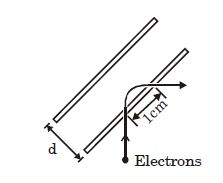
- 2A problem of practical interest is to make a beam of electrons turn at $90^o$ corner. This can be done with the electric field present between the parallel plates as shown in the figure. An electron with kinetic energy $8.0 × 10^{-17}\ J$ enters through a small hole in the bottom plate. The strength of electric field that is needed if the electron is to emerge from an exit hole $1.0\ cm$ away from the entrance hole, traveling at right angles to its original direction is $y × 10^5\ N/C$ . The value of $y$ isView Solution
- 3A parallel plate capacitor has a uniform electric field $E$ in the space between the plates. If the distance between the plates is $d$ and area of each plate is $A,$ the energy stored in the capacitor isView Solution
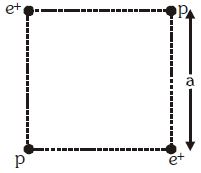
- 4Two positrons $(e^+)$ and two protons $(p)$ are kept on four corners of a square of side $a$ as shown in figure. The mass of proton is much larger than the mass of positron. Let $q$ denotes the charge on the proton as well as the positron then the kinetic energies of one of the positrons and one of the protons respectively after a very long time will be-View Solution
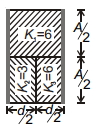
- 5How much work is required to carry a $6$ $\mu C$ charge from the negative terminal to the positive terminal of a $9\, V$ batteryView Solution
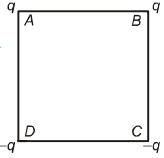
- 6Charges are placed on the vertices of a square as shown Let $\vec E$ be the electric field and $V$ the potential at the centre. If the charges on $A$ and $B$ are interchanged with those on $D$ and $C$ respectively, thenView Solution
- 7A charge $ + q$ is fixed at each of the points $x = {x_0},\,x = 3{x_0},\,x = 5{x_0}$..... $\infty$, on the $x - $axis and a charge $ - q$ is fixed at each of the points $x = 2{x_0},\,x = 4{x_0},x = 6{x_0}$,..... $\infty$. Here ${x_0}$ is a positive constant. Take the electric potential at a point due to a charge $Q$ at a distance $r$ from it to be $Q/(4\pi {\varepsilon _0}r)$. Then, the potential at the origin due to the above system of charges isView Solution
- 8An electric dipole of moment $p$ is placed in an electric field of intensity $E.$ The dipole acquires a position such that the axis of the dipole makes an angle $\theta$ with the direction of the field. Assuming that the potential energy of the dipole to be zero when $\theta = 90^o$ , the torque and the potential energy of the dipole will respectively beView Solution
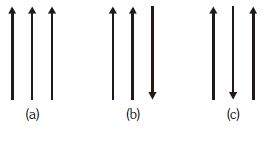
- 9When three electric dipoles are near each other, they each experience the electric field of the other two, and the three dipole system has a certain potential energy. Figure below shows three arrangements $(1)$ , $(2)$ and $(3)$ in which three electric dipoles are side by side. All three dipoles have the same magnitude of electric dipole moment, and the spacings between adjacent dipoles are identical. If $U_1$ , $U_2$ and $U_3$ are potential energies of the arrangements $(1)$ , $(2)$ and $(3)$ respectively thenView Solution
- 10View SolutionThree different dielectrics are filled in a parallel plate capacitor as shown. What should be the dielectric constant of a material, which when fully filled between the plates produces same capacitance?