Question
Two equal forces have their resultant equal to either. What is the inclination between them?

Answer

Here, A = F; B = F, R = F

$\text{R}=\sqrt{\text{A}^2+\text{B}^2+2\text{AB}\cos\theta}$

$\text{F}=\sqrt{\text{F}^2+\text{F}^2+2\text{F}.\text{F}\cos\theta}$

$\text{F}=\text{F}\sqrt{2(1+\cos\theta)}$

$1=2(1+\cos\theta)$

$\cos\theta=-\frac{1}{2}=\cos120^\circ$

$\theta=120^\circ$

Need a full question paper?

Generate a complete, print-ready paper with questions like this in minutes — across 16+ boards, with answer keys.
Start Generating Free

Similar questions

The bob of a simple pendulum is hollow and has been filled with water. There is a small hole below it. If this sphere continuously performs simple harmonic motion and water keeps falling out of the hole, then how will the period of oscillations change?
The velocity of the jet of rocket is $9 km / s$. If 300 kg gas is deposited every second, find the force applied on the rocket
Prove that when there is an angle $\frac{2}{3} \pi$ between two vectors of equal magnitude, then the magnitude of resultant vector will be equal to the magnitude of one of the vectors.
If the density of a gas is kept constant but the root mean square velocity of the gas molecules is doubled, then how many times will the pressure of the gas increase?
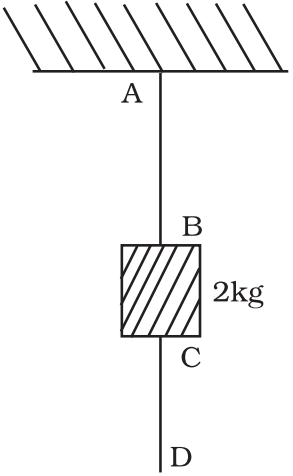
A mass of 2kg is suspended with thread AB Thread CD of the same type is attached to the other end of 2kg mass. Lower thread is pulled gradually, harder and harder in the downward directon so as to apply force on AB. Which of the threads will break and why?

When a boron nucleus $\big(\text{ }^{10}_5\text{B}\big)$ is bombarded by a neutron, an $\alpha$-particle is emitted. Which nucleus will be formed as a result?
A body is travelling in a straight line with a uniformly increasing speed. Plot a graph which represents the change in distance (s) travelled with time (t).
A satellite is moving in a circular orbit of radius $R$. If the radius is increased to $1.02 R$ then what will be the percentage change in its period?
Two wires A and B are of the same material. Their lengths are in the ratio 1 : 2 and the diameters in the ratio 2 : 1 If they are pulled by the same force, then what will be the ratio of their increase in lengths?
A player throws a ball upwards with an initial speed of 29.4m s–1.
What are the velocity and acceleration of the ball at the highest point of its motion?