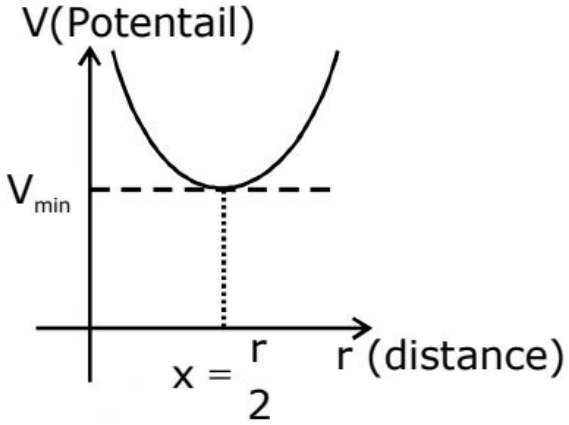
- Continuously increases.
- Continuously decreases.
- Increases then decreases.
- Decreases then increases.

Explanation:

$\text{V}=\frac{\text{KQ}}{\text{r}}$
V → Electric Potential

$\text{V}_\text{p}=\frac{\text{KQ}}{\text{x}}+\frac{\text{KQ}}{\text{r}-\text{x}}=\frac{\text{KQ}\text{r}}{\text{x}(\text{r}-\text{x})}$
$\frac{\text{dvp}}{\text{dx}}=\frac{-\text{kQr}(\text{r}-2\text{x})}{\big(\text{r}(\text{r}-\text{x})\big)^2}=0$

$\text{r}=2\text{x},\ \text{x}=\frac{\text{r}}{2}$
$\text{V}_\text{Pmin}=\frac{\text{KQ}}{\frac{\text{r}}{2}}+\frac{\text{KQ}}{\frac{\text{r}}{2}}=\frac{4\text{KQ}}{\text{r}}$ at $\Big(\text{x}=\frac{\text{r}}{2}\Big)$
Generate a complete, print-ready paper with questions like this in minutes — across 16+ boards, with answer keys.
When a lamp is connected in series with capacitor, then
|
(a) Lamp will not glow |
(b) Lamp will burst out |
|
(c) Lamp will glow normally |
(d) None of these |
Energy of the electron in nth orbit of hydrogen atom is given by
. The amount of energy needed to transfer electron from first orbit to third orbit is
|
(a) 13.6 eV |
(b) 3.4 eV |
(c) 12.09 eV |
(d) 1.51 eV |
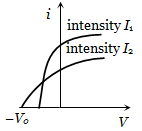
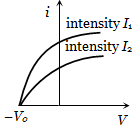
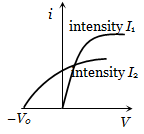
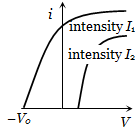
The curves (a), (b) (c) and (d) show the variation between the applied potential difference (V) and the photoelectric current (i), at two different intensities of light (I1 > I2). In which figure is the correct variation shown
|
(a)
|
(b)
|
(c)
|
(d)
|
If current flowing through shell of previous objective is equal to i, then energy density at a point distance 2R from axis of the shell varies according to the graph
|
(a) |
(b) |
(c) |
(d) |
In a nuclear reaction, which of the following is conserved
|
(a) Atomic number |
|
(b) Mass number |
|
(c) Atomic number, mass number and energy |
|
(d) None of these |
An amplitude modulated wave is modulated to 50%. What is the saving in power if carrier as well as one of the side bands are suppressed
|
(a) 70% |
(b) 65.4% |
(c) 94.4% |
(d) 25.5% |
A study of binary stars is most helpful in
|
(a) Finding their distances |
(b) Finding their temperature |
|
(c) Finding their masses |
(d) Verifying Newton's force law of gravitation |
A coil of 40 W resistance has 100 turns and radius 6 mm is connected to ammeter of resistance of 160 ohms. Coil is placed perpendicular to the magnetic field. When coil is taken out of the field, 32 m C charge flows through it. The intensity of magnetic field will be
|
(a) 6.55 T |
(b) 5.66 T |
(c) 0.655 T |
(d) 0.566 T |