MCQ
Two free parallel wires carrying currents in opposite direction,
  • A
    attract each other
  • repel each other.
  • C
    neither attract nor repel.
  • D
    get rotated to be perpendicular to each other.

Answer

Correct option: B.
repel each other.
B

Need a full question paper?

Generate a complete, print-ready paper with questions like this in minutes — across 16+ boards, with answer keys.
Start Generating Free

Similar questions

A transverse pulse generated at the bottom of a uniform rope of length $L$, travels in upward direction. The time taken by it to travel the full length of rope will be
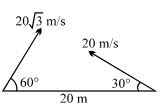
In the figure shown, the two projectiles are fired simultaneously. The minimum distance between them during their flight is  ........ $m$
If an interference pattern have maximum and minimum intensities in $36 : 1$ ratio then what will be the ratio of amplitudes
A ball is dropped from a height of $5\,\,m$  onto a sandy floor and penetrates the sand up to $1\,\,m$  before coming to rest. The retardation of the ball in sand (assuming it to be uniform) will be ................ $\mathrm{m}/ \mathrm{s}^2$
$Assertion :$ Bodies radiate heat at all temperature.
$Reason :$ Rate of radiation of heat is proportional to the fourth power of absolute temperature.
The distance of neptune and saturn from sun are nearly ${10^{13}}$ and ${10^{12}}$ meters respectively. Assuming that they move in circular orbits, their periodic times will be in the ratio
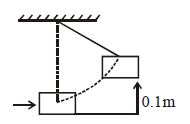
A bullet of mass $0.01\, kg$ and travelling at a speed of $500\, m/s$ strikes and passes horizontally through a block of mass $2\,kg$ which is suspended by string of string of length $5\,m$. The centre of gravity of the block is found to raise a vertical distance of $0.1\,m$. What is the speed of the bullet after it emerges from the block .......... $\mathrm{m}/ \mathrm{s}$ $[g = 9.8\,m/s^2]$ (time of passing of bullet is negligible)
For transistor action, which of the following statements is correct$?$
A uniform conducting wire of length $12 \mathrm{a}$ and resistance $'R'$ is wound up as a current carrying coil in the shape of,

$(i)$ an equilateral triangle of side $'a'.$

$(ii)$ a square of side $'a'.$

The magnetic dipole moments of the coil in each case respectively are:

At two points $P$ and $Q$ on screen in Young's double slit experiment, waves from slits $S_1$ and $S_2$ have a path difference of $0$ and $\frac {\lambda }{4}$ respectively. the ratio of intensities at $P$ and $Q$ will be