Two friends $A$ and $B$ are waiting for another friend for tea. $A$ took the tea in a cup and mixed the cold milk and then waits. $B$ took the tea in the cup and then mixed the cold milk when the friend comes. Then the tea will be hotter in the cup of
Medium
Download our app for free and get started
(a) The rate of heat loss is proportional to the difference in temperature. The difference of temperature between the tea in cup $A$ and the surrounding is reduced, so it loses less heat. the tea in cup $B$ loses more heat because of large temperature difference. Hence the tea in cup $A$ will be hotter.

Download our appand get started for free
Experience the future of education. Simply download our apps or reach out to us for more information. Let's shape the future of learning together!No signup needed.*
Similar Questions
- 1For the shown figure, calculate the equivalent thermal resistance if the bricks made of the same material of conductivity $K$View Solution
- 2If wavelength of maximum intensity of radiation emitted by Sun and Moon are $0.5 \times 10^{-4} \,m$ and $10^{-4}\,m$ respectively, then the ratio of their temperature is ............View Solution
- 3Inside a closed furnace held at a temperature of $400\,\, K,$ we have a black body. A hole of area $10\,\, cm^2$ is opened in the furnace so that sunlight starts falling on black body. The intensity of sunlight is $2000\, W/m^2.$ In the steady stateView Solution
- 4A beaker full of hot water is kept in a room. If it cools from $80^{\circ} C$ to $75^{\circ} C$ in $t_1$, minutes, from $75^{\circ} C$ to $70^{\circ} C$ in $t_2$ minutes and from $70^{\circ} C$ to $65^{\circ} C$ in $t_3$ minutes, thenView Solution
- 5View SolutionHow is the temperature of stars determined by
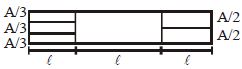
- 6A composite rod made of three rods of equal length and cross-section as shown in the fig. The thermal conductivities of the materials of the rods are $K/2, 5K$ and $K$ respectively. The end $A$ and end $B$ are at constant temperatures. All heat entering the face Agoes out of the end $B$ there being no loss of heat from the sides of the bar. The effective thermal conductivity of the bar isView Solution

- 7Bottom of a lake is at $0^{\circ} C$ and atmospheric temperature is $-20^{\circ} C$. If $1 cm$ ice is formed on the surface in $24 \,h$, then time taken to form next $1 \,cm$ of ice is ......... $h$View Solution
- 8A bowl filled with very hot soup cools from $98^{\circ}\,C$ to $86^{\circ}\,C$ in $2$ minutes when the room temperature is $22^{\circ}\,C$. $..........\,minutes$ long it will take to cool from $75^{\circ}\,C$ to $69^{\circ}\,C$ ?View Solution
- 9A room is maintained at ${20^o}C$ by a heater of resistance $20$ ohm connected to $200$ volt mains. The temperature is uniform through out the room and heat is transmitted through a glass window of area $1{m^2}$ and thickness $0.2$ cm. What will be the temperature outside ....... $^oC$ ? Given that thermal conductivity $K=0.2$ for glass is and $J = 4.2 J/cal$View Solution
- 10View SolutionAccording to Wein's law