A composite rod made of three rods of equal length and cross-section as shown in the fig. The thermal conductivities of the materials of the rods are $K/2, 5K$ and $K$ respectively. The end $A$ and end $B$ are at constant temperatures. All heat entering the face Agoes out of the end $B$ there being no loss of heat from the sides of the bar. The effective thermal conductivity of the bar is

Diffcult
Download our app for free and get started
by given concept
$\frac{3 l}{K}=\frac{l}{k / 2}+\frac{l}{5 k}+\frac{l}{k}$
$\frac{3 l}{K}=\frac{2 l}{k}+\frac{l}{5 k}+\frac{l}{k}=\frac{10 l+l+5 l}{5 k}=\frac{16 l}{5 k}$
$K=\frac{15 k}{16}$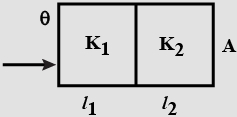

Download our appand get started for free
Experience the future of education. Simply download our apps or reach out to us for more information. Let's shape the future of learning together!No signup needed.*
Similar Questions
- 1The lengths and radii of two rods made of same material are in the ratios $1 : 2$ and $2 : 3$ respectively. If the temperature difference between the ends for the two rods be the same, then in the steady state, the amount of heat flowing per second through them will be in the ratioView Solution
- 2The ratio of radiant energies radiated per unit surface area by two bodies is $16 : 1$ , the temperature of hotter body is $1000K$ , then the temperature of colder body will be ....... $K$View Solution
- 3A body cools from ${60^o}C$ to ${50^o}C$ in $10$ minutes. If the room temperature is ${25^o}C$ and assuming Newton's law of cooling to hold good, the temperature of the body at the end of the next $10$ minutes will be ......... $^oC$View Solution
- 4View SolutionThe rates of cooling of two different liquids put in exactly similar calorimeters and kept in identical surroundings are the same if
- 5The ends of two rods of different materials with their thermal conductivities, radii of cross-sections and lengths all are in the ratio $1:2$ are maintained at the same temperature difference. If the rate of flow of heat in the larger rod is $4\;cal/\sec $, that in the shorter rod in $cal/\sec $ will beView Solution
- 6On observing light from three different stars $P, Q$ and $R$, it was found that intensity of violet colour is maximum in the spectrum of $P$, the intensity of green colour is maximum in the spectrum of $R$ and the intensity of red colour is maximum in the spectrum of $Q$. If $T_P, T_Q$ and $T_R$ are the respective absolute temperatures of $P, Q$ and $R$, then it can be concluded from the above observations thatView Solution
- 7Two friends $A$ and $B$ are waiting for another friend for tea. $A$ took the tea in a cup and mixed the cold milk and then waits. $B$ took the tea in the cup and then mixed the cold milk when the friend comes. Then the tea will be hotter in the cup ofView Solution
- 8Shown below are the black body radiation curves at temperatures $T1$ and $T2$ (T2>T1). Which of the following plots is correctView Solution
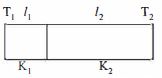
- 9One end of a thermally insulated rod is kept at a temperature $T_1$ and the other at $T_2$ . The rod is composed of two sections of length $l_1$ and $l_2$ and thermal conductivities $K_1$ and $K_2$ respectively. The temperature at the interface of the two section isView Solution
- 10View SolutionIf a liquid is heated in weightlessness, the heat is transmitted through