MCQ
Two gaseous equilibria $S{O_{2(g)}} + \frac{1}{2}{O_{2(g)}}$ $\rightleftharpoons$ $S{O_{3(g)}}$ and $2S{O_{3(g)}}$ $\rightleftharpoons$ $2S{O_{2(g)}} + {O_{2(g)}}$ have equilibrium constants ${K_1}$ and ${K_2}$ respectively at $298\,K$. Which of the following relationships between ${K_1}$ and ${K_2}$ is correct
  • A
    ${K_1} = {K_2}$
  • B
    ${K_2} = K_1^2$
  • ${K_2} = \frac{1}{{K_1^2}}$
  • D
    ${K_2} = \frac{1}{{{K_1}}}$

Answer

Correct option: C.
${K_2} = \frac{1}{{K_1^2}}$
(c)${{K}_{1}}=\frac{[S{{O}_{3}}]}{[S{{O}_{2}}]\,\,{{[{{O}_{2}}]}^{{1}/{2}\;}}}$  and  ${{K}_{2}}=\frac{{{[S{{O}_{2}}]}^{2}}[{{O}_{2}}]}{{{[S{{O}_{3}}]}^{2}}}$ ;   ${{K}_{2}}=\frac{1}{K_{1}^{2}}$

Need a full question paper?

Generate a complete, print-ready paper with questions like this in minutes — across 16+ boards, with answer keys.

Start Generating Free

Similar questions

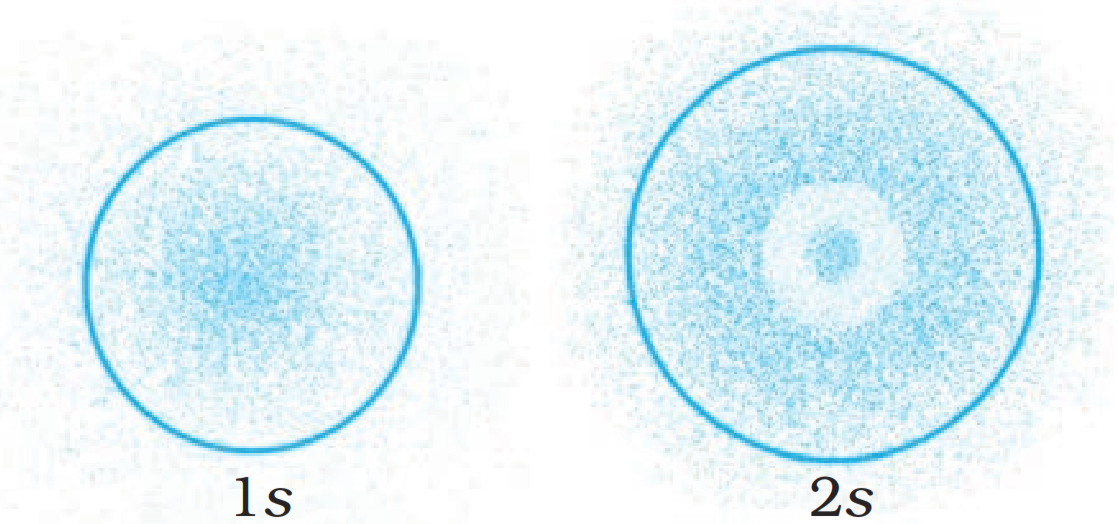
The probability density plots of $1s$ and $2s$ orbitals are given in Fig :

The density of dots in a region represents the probability density of finding electrons in the region.
On the basis of above diagram which of the following statements is incorrect?
The strongest Bronsted base in the following anion is
Two solution labelled as $3\, M\, HCl$ and $1M\, HCl$ are mixed in the ratio of $x : y$ by volume and the molarity of resulting solution is $1.5\, M.$ What is the molarity of the  resulting  solution if they are mixed in the ratio $y : x$ by volume ? ............ $\mathrm{M}$
$100\, mL$ of $0.1\, M\, HCl$ is taken in a beaker andto it $100\, mL$ of $0.1\, M\, NaOH$ is added in steps of $2\, mL$ and the $pH$ is continuously measured.

Which of the following graphs correctly depicts the change in $pH?$

The number of following factors which affect the percent covalent character of the ionic bond is $............$.

$(a)$ Polarising power of cation

$(b)$ Extent of distortion of anion

$(c)$ Polarisability of the anion

$(d)$ Polarising power of anion

Hydroboration of $1$- methylcyclopentene using $B_2D_6$ , followed by  treatment with alkaline hydrogen peroxide, gives
The number of moles of solute present in 1 kg of solvent is called:
$1\ mL$ of $\frac{\text{N}}{100}\text{HCl} $ is added to $1L$ of buffer having $pH = 5$. The $pH$ of the solution will be:
Which of the following has zero dipole moment?
What is the work done when $1\, mole$ of a gas expands isothermally and reversibly from $25\, L$ to $250\, L$ at a temperature of $300\, K$?....$J$