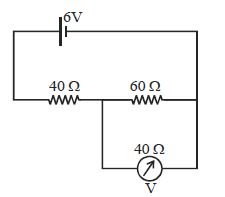
Two heater wires of equal length are first connected in series and then in parallel. The ratio of heat produced in the two cases is
AIIMS 2000, Medium


Download our appand get started for free
Experience the future of education. Simply download our apps or reach out to us for more information. Let's shape the future of learning together!No signup needed.*
Similar Questions
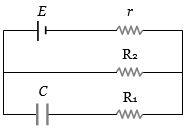
- 1In the given figure each plate of capacitance $C$ has partial value of chargeView Solution
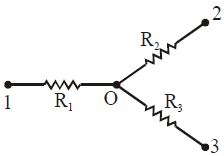
- 2.............. $A$ the current flowing through the resistance $R_2$ of the circuit shown in fig if the resistance are equal to $R_1 = 20\ \Omega, R_2 = 30 \ \Omega$ and $R_3 = 60 \ \Omega$ and potentials of points $1, 2$ and $3$ are equal to $V_1= 20\, V,$ $V_2 = 30\ V$ and $V_3 = 60\ V$View Solution
- 3$A$ total charge $Q$ flows across a resistor $R$ during a time interval $= T$ in such a way that the current vs. time graph for $0 \rightarrow T$ is like the loop of a sin curve in the range $0 \rightarrow \pi$ . The total heat generated in the resistor isView Solution
- 4In the given circuit, the potential of the point $E$ isView Solution
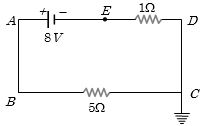
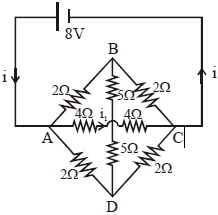
- 5The value of current $i_{1}$ flowing from $A$ to $C$ in the circuit diagram is$.......A$View Solution
- 6The charge flowing in a conductor changes with time as $Q ( t )=\alpha t -\beta t ^2+\gamma t ^3$. Where $\alpha, \beta$ and $\gamma$ are constants. Minimum value of current is :View Solution
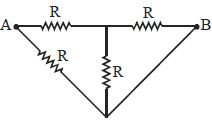
- 7Find equivalent resistance $A$ and $B$View Solution
- 8Two bulbs are in parallel and they together consume $48\, W$ from a battery of $6\, V$. The resistance of each bulb is ............ $\Omega$View Solution
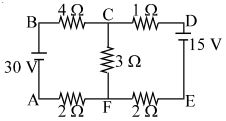
- 9The figure shows a network of five resistances and two batteries The current through the $15\,V$ battery is .............. $A$View Solution
- 10The reading of voltmeter in the circuit shown is ............. $V$View Solution