Two hollow conducting spheres of radii $R_{1}$ and $R_{2}$ $\left(R_{1}>>R_{2}\right)$ have equal charges. The potential would be:
NEET 2022, Easy


Download our appand get started for free
Experience the future of education. Simply download our apps or reach out to us for more information. Let's shape the future of learning together!No signup needed.*
Similar Questions
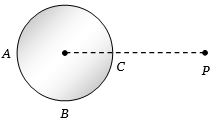
- 1A hollow conducting sphere is placed in an electric field produced by a point charge placed at $P$ as shown in figure. Let ${V_A},{V_B},{V_C}$ be the potentials at points $A,B$ and $C$ respectively. ThenView Solution
- 2A parallel plate capacitor is connected to a battery. The quantities charge, voltage, electric field and energy associated with the capacitor are given by $Q_0, V_0, E_0$ and $U_0$ respectively. A dielectric slab is introduced between plates of capacitor but battery is still in connection. The corresponding quantities now given by $Q, V, E$ and $U$ related to previous ones areView Solution
- 3A charge is spread non-uniformly on the surface of a hollow sphere of radius $R$, such that the charge density is given by $\sigma=\sigma_0(1-\sin \theta)$, where $\theta$ is the usual polar angle. The potential at the centre of the sphere isView Solution
- 4View SolutionWork done by an external agent in separating the parallel plate capacitor is
- 5A $500\,\mu F$ capacitor is charged at a steady rate of $100\,\mu C/sec$ . The potential difference across the capacitor will be $10\,V$ after an interval of......$sec$View Solution
- 6A capacitor of capacity $C$ has charge $Q$ and stored energy is $W$. If the charge is increased to $2Q$, the stored energy will beView Solution
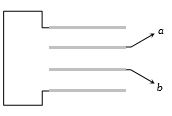
- 7Four metallic plates each with a surface area of one side $A$ are placed at a distance $d$ from each other. The plates are connected as shown in the circuit diagram. Then the capacitance of the system between $a$ and $b$ isView Solution
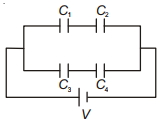
- 8Find the charge on capacitor $C_3$View Solution
Given, that $C_1=C_2=C$ and $C_3=C_4=3 C$.
- 9The capacity of a parallel plate condenser is $15\,\mu \,F$, when the distance between its plates is $6 \,cm$. If the distance between the plates is reduced to $2\, cm$, then the capacity of this parallel plate condenser will be......$\mu \,F$View Solution
- 10If $q$ is the charge per unit area on the surface of a conductor, then the electric field intensity at a point on the surface isView Solution