Question
Two identical balls $A$ and $B$ are released from the positions shown in figure. They collide elastically on horizontal portion $MN$. The ratio of the height attained by $A$ and $B$ after collision will be: (neglect friction)
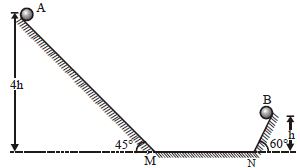
$v_{A}=\sqrt{2 g h} \quad \text { and } \quad v_{B}=2 \sqrt{2 g h}$
Height attained by $A$ will be
$\mathrm{h}_{\mathrm{A}}=\frac{\mathrm{v}_{\mathrm{A}}^{2}}{2 \mathrm{g}}=\mathrm{h}$ $...(1)$
But path of $B$ will be first straight line from $N$ to $\mathrm{P}$ and then parabolic from point $\mathrm{P}$ as shown in fig.
Calculation of max height attained by $B.$ velocity of $\mathrm{B}$ at point $\mathrm{P}$
$\mathrm{v}_{\mathrm{B}}^{\prime 2}=\mathrm{v}_{\mathrm{B}}^{2}-2 \mathrm{gh}=6 \mathrm{gh}$ $...(2)$
After reaching at point $P$ it will move in parabolic height.
So here $h^{\prime}=\frac{v_{B}^{\prime 2}\left(\sin 60^{\circ}\right)^{2}}{2 g}=\frac{9 h}{4}$
$\Rightarrow$ max. height attained by $\mathrm{B}$
$h_{B}=h+h^{\prime}=h+\frac{9 h}{4}=\frac{13 h}{4}$ $...(3)$
from eq" $( 1)$ $\&$ $(3)$
$\frac{h_{A}}{h_{B}}=\frac{4}{13}$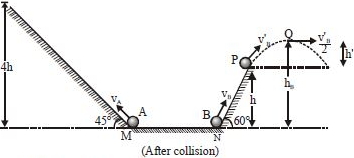
Generate a complete, print-ready paper with questions like this in minutes — across 16+ boards, with answer keys.
| List - $I$ | List - $II$ |
| $(a)$ Source of microwave frequency | $(i)$ Radioactive decay on nucleus |
| $(b)$ Source of infrared frequency | $(ii)$ Magnetron |
| $(c)$ Source of Gamma Rays | $(iii)$ Inner shell electrons |
| $(d)$ Source of $X-$rays | $(iv)$ Vibration of atoms and molecules |
| $(v)$ $LASER$ | |
| $(vi)$ $RC$ circuit |
Choose the correct answer from the options given below :