- Athe thread will become taut at $t = (L/v)$
- Bthe thread will become taut at some time $t < (L/v).$
- Cthe thread will always remain taut for $t > (L/v).$
- ✓Both $(A)$ and $(C)$
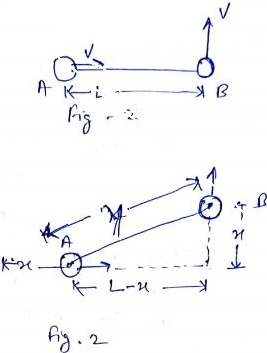
$L^{2}=x^{2}+L^{2}+x^{2}-2 l x$
$2 x^{2}-2 L x=0$
$2 x(x-L)=0$
$x=L$
time taken to travel $x=t=\frac{x}{V}=\left(\frac{L}{V}\right)$ thread will taught at $x=L$ and time $t=\frac{1}{2}$ and after that thread always taught because $y=\sqrt{x^{2}-\left(L-x^{2}\right)}$
$y>L d \quad f x>L$
Generate a complete, print-ready paper with questions like this in minutes — across 16+ boards, with answer keys.
$(i)$ Radiation
$(ii)$ Energy conversion
$(iii)$ Melting
$(iv)$ Thermal expansion
$y = A{e^{ - \frac{{bt}}{{2m}}}}\sin (\omega 't + \phi )$
where the symbols have their usual meanings. If a $2\ kg$ mass $(m)$ is attached to a spring of force constant $(K)$ $1250\ N/m$ , the period of the oscillation is $\left( {\pi /12} \right)s$ . The damping constant $‘b’$ has the value. ..... $kg/s$