MCQ
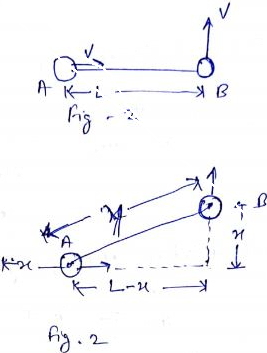
Two identical balls are interconnected with a massless and inextensible thread. The system is in gravity free space with the thread just taut. Each ball is imparted a velocity $v$, one towards the other ball and the other perpendicular to the first, at $t = 0$. Then,
  • A
    the thread will become taut at $t = (L/v)$
  • B
    the thread will become taut at some time $t < (L/v).$
  • C
    the thread will always remain taut for $t > (L/v).$
  • Both $(A)$ and $(C)$

Answer

Correct option: D.
Both $(A)$ and $(C)$
d
As shown in figure $A$ and $B$ are two identical mass. Suppose $A$ move $x$ and $B$ move $x=$ because velocity is same. Length taught when $y>L$ $L=\sqrt{x^{2}+(L-x)^{2}}$

$L^{2}=x^{2}+L^{2}+x^{2}-2 l x$

$2 x^{2}-2 L x=0$

$2 x(x-L)=0$

$x=L$

time taken to travel $x=t=\frac{x}{V}=\left(\frac{L}{V}\right)$ thread will taught at $x=L$ and time $t=\frac{1}{2}$ and after that thread always taught because $y=\sqrt{x^{2}-\left(L-x^{2}\right)}$

$y>L d \quad f x>L$

Need a full question paper?

Generate a complete, print-ready paper with questions like this in minutes — across 16+ boards, with answer keys.

Start Generating Free

Similar questions

The amplitude and the time period in a $S.H.M.$ is $0.5 \,cm$ and $0.4 \,sec$ respectively. If the initial phase is $\pi /2$ radian, then the equation of $S.H.M.$ will be
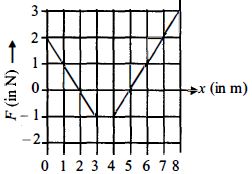
The force $\vec F\, = F\hat i$ on a particle of mass $2\, kg$, moving along the $x-$ axis is given in the figure as a function of its position $x$. The particle is moving with a velocity of $5\, m/s$ along the $x-$ axis at $x\, = 0$. What is the kinetic energy of the particle at $x\,= 8\, m$ ? .................. $\mathrm{J}$
A simple harmonic motion having an amplitude $A$ and time period $T$ is represented by the equation : $y = 5 \sin \pi (t + 4) m$

Then the values of $A$ (in $m$) and $T$ (in $sec$) are :

$1 \,kg$ of ice at $-20^{\circ} C$ is mixed with $2 \,kg$ of water at $90^{\circ} C$. Assuming that there is no loss of energy to the environment, the final temperature of the mixture is ............ $^{\circ} C$ (Assume, latent heat of ice $=334.4 \,kJ / kg$, specific heat of water and ice are $4.18 \,kJ kg ^{-1} K ^{-1}$ and $2.09 \,kJ kg ^{-1}- K ^{-1}$, respectively.)
The engine of a train sounds a whistle at frequency v. The frequency heard by a passenger is:

  1. $>\text{v}$

  2. $<\text{v}$

  3. $=\frac{1}{\text{v}}$

  4. $=\text{v}$

A player kicks a football with an initial speed of $25\, {ms}^{-1}$ at an angle of $45^{\circ}$ from the ground. What are the maximum height and the time taken by the football to reach at the highest point during motion ? (Take g $=10 \,{ms}^{-2}$ )
Unit vector does not have any .......
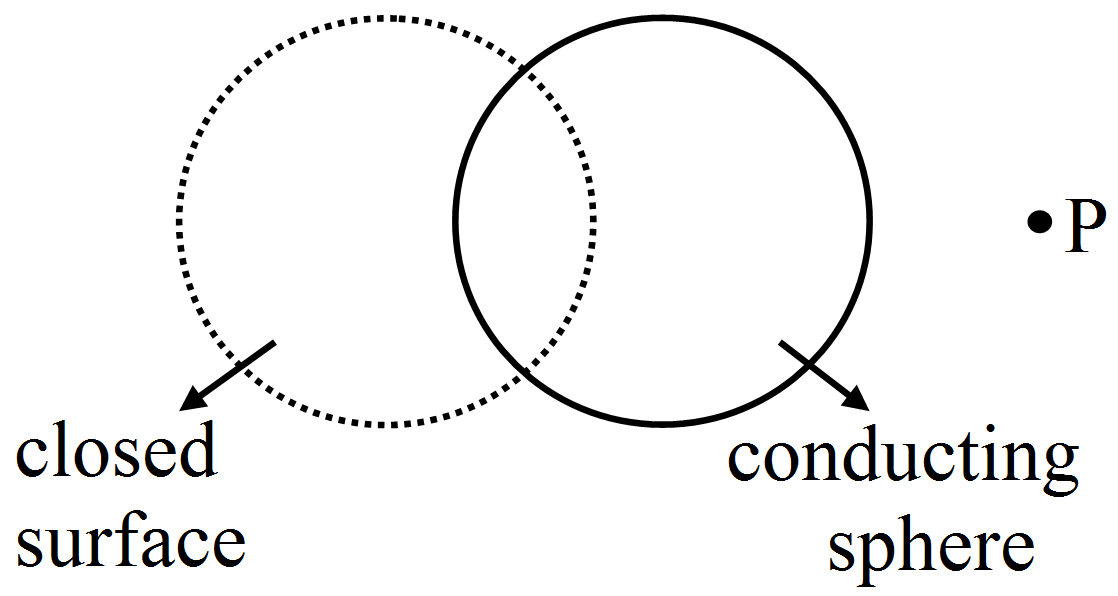
Figure shows a closed surface which intersects a conducting sphere. If a positive charged is placed at the point P, the flux of the electic field through the closed surface:

  1. Will remain zero.
  2. Will become positive.
  3. Will become neagative.
  4. Will become undefined.
A spring with spring constant k when stretched through $1\, cm$, the potential energy is $U$. If it is stretched by $4 \,cm.$ The potential energy will be
The ratio of the dimension of Planck's constant and that of moment of inertia is the dimension of