- ✓$4$
- B$3$
- C$2$
- D$1$
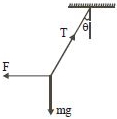
$\frac{\mathrm{F}}{\mathrm{mg}}=\tan \theta$ ..........$(i)$
when suspended in liquid, as $\theta$ remains same,
$\frac{\mathrm{F}^{\prime}}{\operatorname{mg}\left(1-\frac{\rho}{\mathrm{d}}\right)}=\tan \theta$ .........$(ii)$
Using eqns. $(i)$ and $(ii),$
$\frac{\mathrm{F}}{\mathrm{mg}}=\frac{\mathrm{F}^{\prime}}{\mathrm{mg}\left(1-\frac{\rho}{\mathrm{d}}\right)}$
where, $\quad \mathrm{F}^{\prime}=\frac{\mathrm{F}}{\mathrm{K}}$
$\therefore \frac{\mathrm{F}}{\mathrm{mg}}=\frac{\mathrm{F}^{\prime}}{\operatorname{mg} \mathrm{K}\left(1-\frac{\rho}{\mathrm{d}}\right)}$
or $\quad \mathrm{K}=\frac{1}{1-\frac{\rho}{\mathrm{d}}}=2$
Generate a complete, print-ready paper with questions like this in minutes — across 16+ boards, with answer keys.