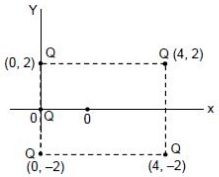
For equal point charges $Q$ each are placed in the $xy$ plane at $(0, 2), (4, 2), (4, -2)$ and $(0, -2)$. The work required to put a fifth change $Q$ at the origin of the coordinate system will be
JEE MAIN 2019, Diffcult


Download our appand get started for free
Experience the future of education. Simply download our apps or reach out to us for more information. Let's shape the future of learning together!No signup needed.*
Similar Questions
- 1View SolutionThe figure shows a diagonal symmetric arrangement of capacitors and a battery.Identify the correct statements.
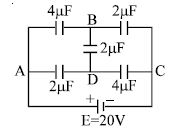
- 2The charge deposited on $4\,\mu F$ capacitor in the circuit isView Solution
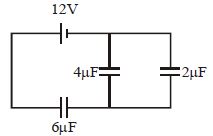
- 3With the rise in temperature, the dielectric constant $K$ of a liquidView Solution
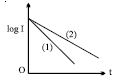
- 4A capacitor of capacity $C$ is charged to a steady potential difference $V$ and connected in series with an open key and a pure resistor $'R'$. At time $t = 0$, the key is closed. If $I =$ current at time $t$, a plot of log $I$ against $'t'$ is as shown in $(1)$ in the graph. Later one of the parameters i.e. $V, R$ or $C$ is changed keeping the other two constant, and the graph $(2)$ is recorded. ThenView Solution
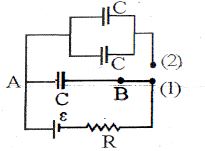
- 5If capacitor connected across $AB$ is charged to $Q$ and then switch is shifted to $2$ . The heat released after thatView Solution
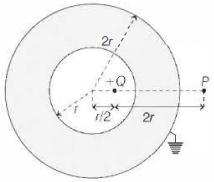
- 6Consider an initially neutral hollow conducting spherical shell with inner radius $r$ and outer radius $2 r$. A point charge $+Q$ is now placed inside the shell at a distance $r / 2$ from the centre. The shell is then grounded by connecting the outer surface to the earth. $P$ is an external point at a distance $2 r$ from the point charge $+Q$ on the line passing through the centre and the point charge $+Q$ as shown in the figure. The magnitude of the force on a test charge $+q$ placed at $P$ will beView Solution
- 7A $500 \,\mu F$ capacitor is charged at a steady rate of $100\, \mu C/sec$. The potential difference across the capacitor will be $10\, V$ after an interval of.....$sec$View Solution
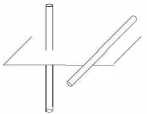
- 8Two mutually perpendicular infinitely long straight conductors carrying uniformly distributed charges of linear densities $\lambda_{1}$ and $\lambda_{2}$ are positioned at a distance $r$ from each other. Force between the conductors depends on $r$ asView Solution
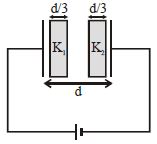
- 9Two dielectric slab of dielectric constant $K_1$ and $K_2$ and of same thickness is inserted in parallel plats capacitor and $K_1 = 2K_2$ . Potential difference across slabs are $V_1$ and $V_2$ respectively thenView Solution
- 10A parallel plate capacitor has plates of area $A$ separated by distance $d$ between them. It is filled with a dielectric which has a dielectric constant that varies as $\mathrm{k}(\mathrm{x})=\mathrm{K}(1+\alpha \mathrm{x})$ where $\mathrm{x}$ is the distance measured from one of the plates. If $(\alpha \text {d)}<<1,$ the total capacitance of the system is best given by the expressionView Solution