Two identical fuses are rated at $10\,A$. If they are joined
Medium


Download our appand get started for free
Experience the future of education. Simply download our apps or reach out to us for more information. Let's shape the future of learning together!No signup needed.*
Similar Questions
- 1If a wire of resistance $R$ is melted and recasted to half of its length, then the new resistance of the wire will beView Solution
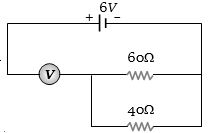
- 2The measurement of voltmeter in the following circuit is ................ $V$View Solution
- 3An electric heater consists of a nichrome coil and runs under $220 \,V$, consuming $1 \,kW$ power. Part of its coil burned out and it was reconnected after cutting off the burnt portion.The power it will cunsume now isView Solution
- 4$E$ denotes electric field in a uniform conductor, $I$ corresponding current through it, ${v_d}$ drift velocity of electrons and $P$ denotes thermal power produced in the conductor, then which of the following graph is incorrectView Solution
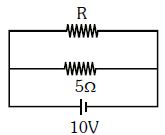
- 5The power dissipated in the circuit shown in the figure is $30\, Watts$. The value of $R$ is ............. $\Omega$View Solution
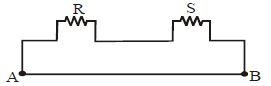
- 6In a meter bridge, the null point is found at a distance of $25\, cm$ from $A$. If now a resistance of $10\,\Omega $ is connected in parallel with $S$, the null point occurs at mid point of $AB$. The value of $R$ is ................. $\Omega$View Solution
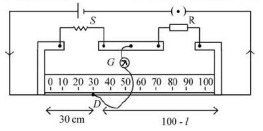
- 7In meter bridge experiment for measuring unknown resistance ' $S$ ', the null point is obtained at a distance $30 cm$ from the left side as shown at point $D$. If $R$ is $5.6 k \Omega$, then the value of unknown resistance ' $S$ ' will be $\Omega .$View Solution
- 8A uniform metallic wire carries a current $2\,A$. when $3.4\,V$ battery is connected across it. The mass of uniform metallic wire is $8.92 \times 10^{-3} \,kg$. density is $8.92 \times 10^3\,kg / m ^3$ and resistivity is $1.7 \times 10^{-8} \Omega- m$. The length of wire is $l=............\,m$View Solution
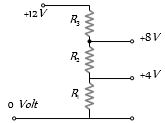
- 9A potential divider is used to give outputs of $4\, V$ and $8\, V$ from a $12\, V$ source. Which combination of resistances, $(R_1, R_2, R_3)$ gives the correct voltages ? $R_1 : R_2 : R_3$View Solution
- 10Two wires of same material have length $L$ and $2L $ and cross-sectional areas $4A$ and $A$ respectively. The ratio of their specific resistance would beView Solution