Two close organ pipe having length $20\,cm$ and $20.5\, cm$ produce $5\, beats/sec$. Determine the frequency of both organ pipe
Medium
Download our app for free and get started
$\mathrm{n} \propto \frac{1}{\ell} \quad \frac{\mathrm{n}_{1}}{\mathrm{n}_{2}}=\frac{\ell_{2}}{\ell_{1}}$
$\frac{\mathrm{N}}{\mathrm{N}+5}=\frac{20}{20.5}$
$20.5 \mathrm{N}=20 \mathrm{N}+5 \times 20$
$0.5 \mathrm{N}=100$
$\mathrm{N}=\frac{100}{0.5}=200 \mathrm{\,Hz}$
$\mathrm{N}+5 \Rightarrow 200+5=205 \mathrm{\,Hz}$

Download our appand get started for free
Experience the future of education. Simply download our apps or reach out to us for more information. Let's shape the future of learning together!No signup needed.*
Similar Questions
- 1A source of sound emits waves with frequency $f \,Hz$ and speed $V\, m/sec$. Two observers move away from this source in opposite directions each with a speed $0.2\, V$ relative to the source. The ratio of frequencies heard by the two observers will beView Solution
- 2The equation of a travelling wave is given by$y = 0.5\sin (20x - 400t)$ where $x$ and $y$ are in meter and $t$ is in second. The velocity of the wave is .... $m/s$View Solution
- 3A guitar string of length $90\,cm$ vibrates with a fundamental frequency of $120\,Hz.$ The length of the string producing a fundamental frequency of $180\,Hz$ will be $...........cm$.View Solution
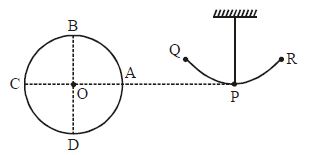
- 4A sound source is moving on a circular path of radius $R$ with constant angular speed $\omega $ in anticlockwise direction and emits a frequency $n$ . An observer performs simple harmonic along the path $QPR$ with time period $T = \frac {2\pi }{\omega }$ as shown in the figure. If at $t = 0$ source is at $A$ and observer is at $Q$ and assume $OP$ is very large as compare to radius $R$ and $QP$ , thenView Solution
- 5The frequency of a tunning fork is $384$ per second and velocity of sound in air is $352 m/s$. How far the sound has traversed while fork completes $36$ vibration .... $m$View Solution
- 6Velocity of sound waves in air is $330\; m/sec$. For a particular sound in air, a path difference of $40 \;cm$ is equivalent to a phase difference of $1.6 \pi$. The frequency of this wave is... $Hz$View Solution
- 7An observer is approaching with a speed $v$, towards a stationary source emitting sound waves of wavelength $\lambda_0$. The wavelength shift detected by the observer is (Take $c=$ speed of sound)View Solution
- 8A string is stretched between two fixed points separated by $75\,cm$ . It is observed to have resonant frequencies of $420\,Hz$ and $315\,Hz$ . There are no other resonant frequencies between these two. Then, the lowest resonant frequency for this string is ..... $Hz$View Solution
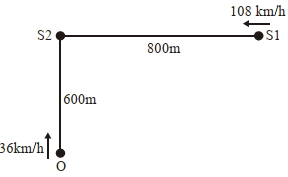
- 9A train $S1$, moving with a uniform velocity of $108 km / h$, approaches another train $S 2$ standing on a platform. An observer $O$ moves with a uniform velocity of $36 km / h$ towards $S 2$, as shown in figure. Both the trains are blowing whistles of same frequency $120 Hz$. When $O$ is $600 m$ away from $S 2$ and distance between $S 1$ and $S 2$ is $800 m$, the number of beats heard by $O$ is. . . . . [Speed of the sound $=330 m / s$ ]View Solution
- 10Source and observer both start moving simultaneously from origin, one along $x-$axis and the other along $y-$axis with speed of source = twice the speed of observer. The graph between the apparent frequency observed by observer $f$ and time $t$ would approximately be :View Solution