Question
Two identical p-ri junctions may be connected in series with a battery in three ways (figure). The potential difference across the two p-n. junctions are equal in:

Answer

  1. Circuit 2 and circuit 3.
Explanation:
In circuit 1, one diode is forward biassed and the other diode is reverse biassed. The forward-biassed diode offers zero resistance (ideally) to the current flow, so it can be replaced by a short circuit. The voltage drop across the first diode will be zero. The second diode is reverse biassed, so it can be replaced by an open circuit; hence, the voltage drop across this diode will be maximum.
In circuit 2, both the diodes are forward biassed, so they can be replaced by short circuits; hence, the voltage drop across both of them will be minimum and equal.
In circuit 3, both the diodes are reverse biassed, so both can be replaced by open circuits; hence, the voltage drop across both of them will be maximum and equal.
Need a full question paper?

Generate a complete, print-ready paper with questions like this in minutes — across 16+ boards, with answer keys.

Start Generating Free

Similar questions

A proton beam is going from north to south and an electron beam is going from south to north. Neglecting the earth's magnetic field, the electron beam will be deflected
  1. Towards the proton beam.
  2. Away from the proton beam.
  3. Upwards.
  4. Downwards.
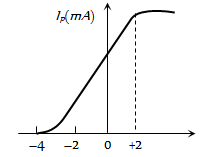
The mutual characteristic curves of a triode are as shown in figure. The cut off voltage for the triode is
Assertion : The positively charged nucleus of an atom has a radius of almost $10^{-15} \mathrm{~m}$
Reason : In $\alpha-$particle scattering experiment, the distance of closest approach for $\alpha-$particles is $\simeq 10^{-15} \mathrm{~m}$
A particle is acted upon by a force of constant magnitude which is always perpendicular to the velocity of the particle. The motion of the particle takes place in a plane. It follows that:
  1. Its velocity is constant.
  2. Its acceleration is constant.
  3. Its kinetic energy is constant.
  4. It moves in a circular path.
An object is placed at 20 cm from a convex mirror of focal length 10 cm. The image formed by the mirror is(a) Real and at 20 cm  from the mirror(b) Virtual and at 20 cm  from the mirror(c) Virtual and at 20/3 cm  from the mirror(d) Real and at 20/3 cm  from the mirror


Assertion : Electron capture occurs more often than positron emission in heavy elements.
Reason    : Heavy elements exhibit radioactivity.(a) If both assertion and reason are true and the reason is the correct explanation of the assertion.(b) If both assertion and reason are true but reason is not the correct explanation of the assertion.(c) If assertion is true but reason is false.(d) If the assertion and reason both are false.


An electric charge $q$ is placed at the centre of a cube of side $\alpha$. The electric flux on one of its faces will be
A potentiometer can measure emf of a cell because:
For which of the following particles will it be most difficult to experimentally verify the de-Broglie relationship?
When the frequency of the source voltage decreases, the impedance of a parallel RC circuit.