Question
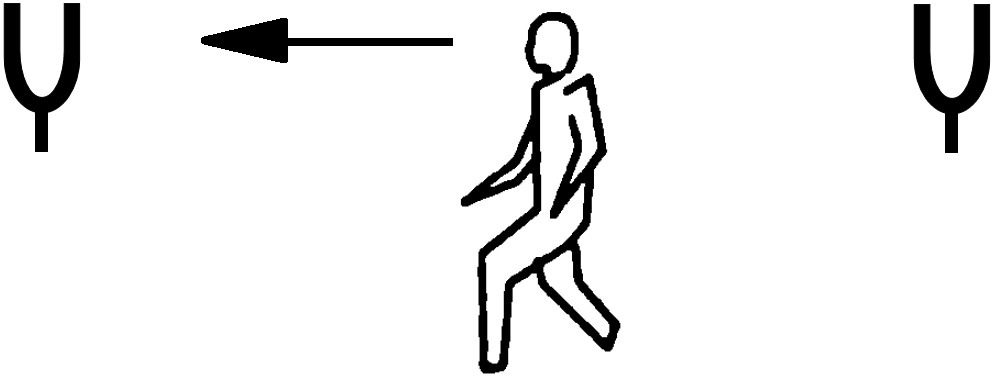
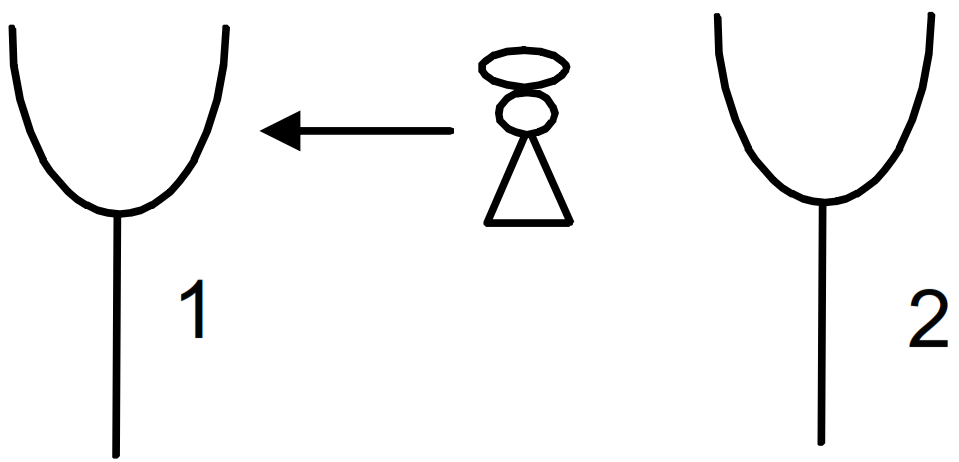
Two identical tuning forks vibrating at the same frequency $256\ Hz$ are kept fixed at some distance apart. $A$ listener runs between the forks at a speed of $3.0\ m/s$ so that he approaches one tuning fork and recedes from the other figure. Find the beat frequency observed by the listener. Speed of sound in air $= 332\ ms/s.$
Answer


Here given velocity of the sources $v_s = 0$
Velocity of the observer $v_0 = 3\ m/s$
So, the apparent frequency heard by the man $=\Big(\frac{332+3}{332}\Big)\times256=258.3\text{ Hz}.$
From the approaching tuning form $= f'$
$\text{f}'=\Big[\frac{(332-3)}{332}\Big]\times256=253.7\text{ Hz}.$
So, beat produced by them $=258.3-253.7=4.6\text{ Hz}.$

Need a full question paper?

Generate a complete, print-ready paper with questions like this in minutes — across 16+ boards, with answer keys.

Start Generating Free

Similar questions

Two identically charged particles are fastened to the two ends of a spring of spring constant $100Nm^{-1}$ and natural length $10\ cm.$ The system rests on a smooth horizontal table. If the charge on each particle is $2.0 \times 10^{-8}C$, find the extension in the length of the spring. Assume that the extension is small as compared to the natural length. Justify this assumption after you solve the problem.
A hydrogen atom in state n = 6 makes two successive transitions and reaches the ground state. In the first transition a photon of 1.13eV is emitted. (a) Find the energy of the photon emitted in the second transition (b) What is the value of n in the intermediate state?
Three capacitors of capacitance 2 pF, 3 pF and 4 pF are connected in parallel.
(a) What is the total capacitance of the combination?
(b) Determine the charge on each capacitor if the combination is connected to a 100 V supply.
C1 = 2 pF
= 2 X 10 -12 F
C2 = 3 pF
3 X 10 -12 F
C3 = 4 pF
= 4 X 10-12 F
A circular coil of one turn of radius 5.0cm is rotated about a diameter w!th a constant angular speed of 80 revolutions per minute. A uniform magnetic field B = 0.010T exists in a direction perpendicular to the axis of rotation. Find
  1. The maximum emf induced.
  2. The average emf induced in the coil over a long period.
  3. The average of the squares of emf induced over a lone period.
A rod of mass m and length L, lying horizontally, is free to rotate about a vertical axis through its centre. A horizontal force of constant magnitude F acts on the rod at a distance of $\frac{\text{L}}{4}$ from the centre. The force is always perpendicular to the rod. Find the angle rotated by the rod during the time (t) after the motion starts.
A person has near point at 100cm. What power of lens is needed to read at 20cm if he/ she uses.
  1. Contact lens,
  2. Spectacles having glasses 2.0cm separated from the eyes?
What is the shape of the wavefront on earth for sunlight?
A tank is filled with water to a height of $12.5 \ cm$. The apparent depth of a needle lying at the bottom of the tank is measured by a microscope to be $9.4 \ cm$. What is the refractive index of water? If water is replaced by a liquid of refractive index $1.63$ up to the same height, by what distance would the microscope have to be moved to focus on the needle again?
Write any two factors on which internal resistance of a cell depends. The reading on a high resistance voltmeter, when a cell is connected across it, is 2.2 V. When the terminals of the cell are also connected to a resistance of 5 Ω as shown in the circuit, the voltmeter reading drops to 1.8 V. Find the internal resistance of the cell.
The energy flux of sunlight reaching the surface of the earth is $1.388 \times 10^3 W / m ^2$. How many photons $($nearly$)$ per square metre are incident on the Earth per second? Assume that the photons in the sunlight have an average wavelength of $550\ nm$ .