MCQ
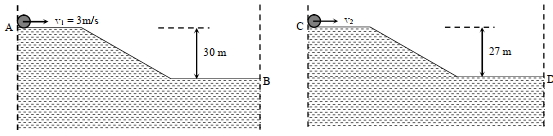
Two identical uniform discs roll without slipping on two different surfaces $AB$ and $CD$ (see figure) starting at $A$ and $C$ with linear speeds $v _1$ and $v _2$, respectively, and always remain in contact with the surfaces. If they reach $B$ and $D$ with the same linear speed and $v_1=3 \ m / s$, then $v_2$ in $m / s$ is $\left(g=10 \ m / s ^2\right)$
  • A
    $5$
  • B
    $6$
  • $7$
  • D
    $8$

Answer

Correct option: C.
$7$
c
Kinetic energy of a pure rolling disc having velocity of centre of mass $v=\frac{1}{2} m v^2+\frac{1}{2}\left(\frac{m R^2}{2}\right) \frac{v^2}{R^2}=\frac{3}{4} m v^2$

So, $\frac{3}{4} m(3)^2+m g(30)=\frac{3}{4} m\left(v_2\right)^2+m g(27) \quad \therefore v_2=7 m / s$

Need a full question paper?

Generate a complete, print-ready paper with questions like this in minutes — across 16+ boards, with answer keys.

Start Generating Free

Similar questions

A charged spherical drop of mercury is in equilibrium in a plane horizontal air capacitor and the intensity of the electric field is $6 × 10^4 $  $Vm^{-1}$. The charge on the drop is $8 × 10^{-18}$ $C$. The radius of the drop is $\left[ {{\rho _{air}} = 1.29\,kg/{m^3};{\rho _{Hg}} = 13.6 \times {{10}^3}kg/{m^3}} \right]$
The $log-log$ graph between the energy $E$ of an electron and its de-Broglie wavelength $\lambda $ will be
If maximum velocity with which an electron can be emitted from a photo cell is $4 \times {10^8}\,cm/\sec $, the stopping potential is ................ $volt$ (mass of electron $= 9 \times 10^{-31} \,kg$)
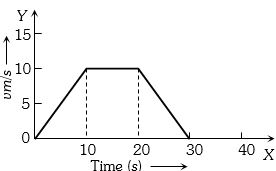
In the following graph, distance travelled by the body in metres is ............. $\mathrm{m}$
A fish looking up through the water sees the outside world contained in a circular horizon. If the refractive index of water is $\frac {4}{3}$ and the fish is $12\,cm$ below the surface, the radius of this circle in $cm$ is
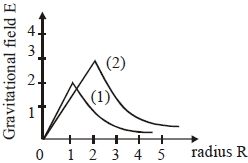
Consider two solid spheres of radii $\mathrm{R}_{1}=1 \;\mathrm{m}$ $\mathrm{R}_{2}=2\; \mathrm{m}$ and masses $\mathrm{M}_{1}$ and $\mathrm{M}_{2},$ respectively. The gravitational field due to sphere $(1)$ and $(2)$ are shown. The value of $\frac{\mathrm{M}_{1}}{\mathrm{M}_{2}}$ is
A uniform solid sphere of mass $m$ and radius $r$ rolls without slipping down a inclined  plane, inclined at an angle $45^o$ to the horizontal. Find the magnitude of minimum  frictional coefficient at which slipping is absent-
A far off planet is estimated to be at a distance $D$ from the earth. If its diametrically opposite extremes subtend an angle $\theta$ at an observatory situated on the earth, the approximate diameter of the planet is ............. 
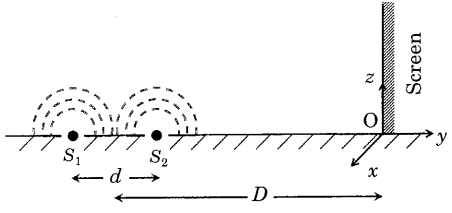
While conducting the Young's double slit experiment, a student replaced the two slits with a large opaque plate in the $x-y$ plane containing two small holes that act as two coherent point sources $\left(S_1, S_2\right)$ emitting light of wavelength $600 \mathrm{~nm}$. The student mistakenly placed the screen parallel to the $x-z$ plane (for $z>0$ ) at a distance $D=3 \mathrm{~m}$ from the mid-point of $S_1 S_2$, as shown schematically in the figure. The distance between the sources $d=0.6003 \mathrm{~mm}$. The origin $\mathrm{O}$ is at the intersection of the screen and the line joining $S_1 S_2$. Which of the following is(are) true of the intensity pattern on the screen?

($A$) Straight bright and dark bands parallel to the $x$-axis

($B$) The region very close to the point $O$ will be dark

($C$) Hyperbolic bright and dark bands with foci symmetrically placed about $\mathrm{O}$ in the $x$-direction

($D$) Semi circular bright and dark bands centered at point $\mathrm{O}$

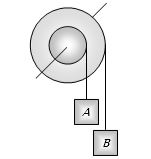
Figure shows a small wheel fixed coaxially on a bigger one of double the radius. The system rotates about the common axis. The strings supporting $A$ and $B$ do not slip on the wheels. If $x$ and $y$ be the distances travelled by $A$ and $B$ in the same time interval, then