Two indentical electric lamps marked $500\, W, \,\,220\, V$ are connected in series and then joined to a $110\, V$ line. The power consumed by each lamp is
Medium
Download our app for free and get started
Voltage across each bulb $V' = \frac{{110}}{2} = 55\,W$
so, power consumed by each bulb will be
$P' = {\left( {\frac{{55}}{{220}}} \right)^2} \times 500$
$ = \frac{{125}}{4}\,W$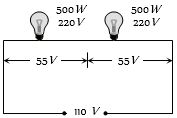

Download our appand get started for free
Experience the future of education. Simply download our apps or reach out to us for more information. Let's shape the future of learning together!No signup needed.*
Similar Questions
- 1Two electric bulbs whose resistance are in the ratio of $1: 2$, are connected in parallel to a constant voltage source. The power dissipated in them has the ratioView Solution
- 2Two wires $A$ and $B$ are made up of the same material and have the same mass. Wire A has radius of $2.0 \mathrm{~mm}$ and wire $B$ has radius of $4.0 \mathrm{~mm}$. The resistance of wire B is $2 \Omega$. The resistance of wire $\mathrm{A}$ is_______. $\Omega$.View Solution
- 3View SolutionIn the experiment of potentiometer, at balance, there is no current in the
- 4There are $0.8 \times 10^{23}$ free electrons $/ cm^3$ in copper. If $0.2\, A $ current is flowing is copper wire, then the drift velocity of electrons will be, if the cross sectional area of wire is $0.01 \,cm^2$View Solution
- 5The storage battery of a car has an $emf$ of $12\; V$. If the internal resistance of the battery is $0.4\; \Omega,$ what is the maximum current (in $A$) that can be drawn from the battery?View Solution
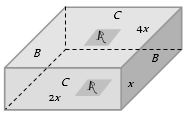
- 6In figure shows a rectangular block with dimensions $x,\, 2x$ and $4x$. Electrical contacts can be made to the block between opposite pairs of faces (for example, between the faces labelled $A-A, B-B$ and $C-C$). Between which two faces would the maximum electrical resistance be obtained ($A-A$ : Top and bottom faces, $B-B$ : Left and right faces, $C-C$ : Front and rear faces)View Solution
- 7View SolutionGiven three equal resistors, how many different combination of all the three resistors can be made
- 8For a cylinder of radius $R$ current density $J =J_0 \frac{r}{R} $, where $J_0$ is a constant and $r$ is distance from axis. Calculate total currentView Solution
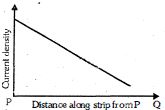
- 9An electric current flows along an insulated strip $PQ$ of a metallic conductor. The current density in the strip varies as shown in graph of figure. Which one of the following statements could explain this variation ?View Solution
- 10Drift velocity ${v_d}$ varies with the intensity of electric field as per the relationView Solution