Question
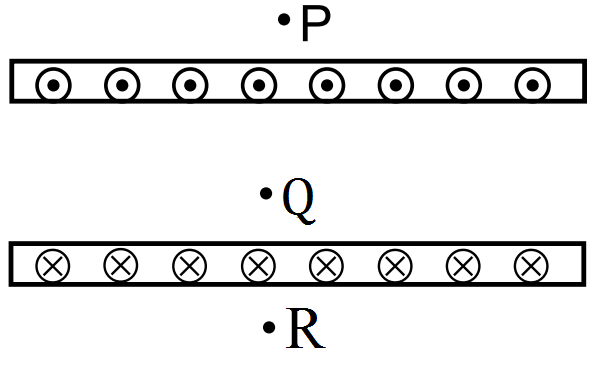
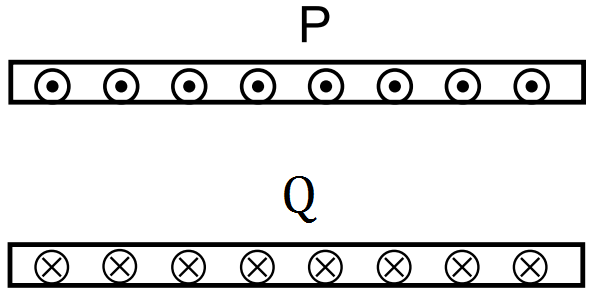
Two large metal sheets carry surface currents as shown in figure. The current through a strip of width dl is Kdl where K is a constant. Find the magnetic field at the points P, Q and R.
Answer


At point P, i = 0, Thus B = 0

At point R, i = 0, B = 0

At point $\theta,$

Applying ampere’s rule to the above rectangle
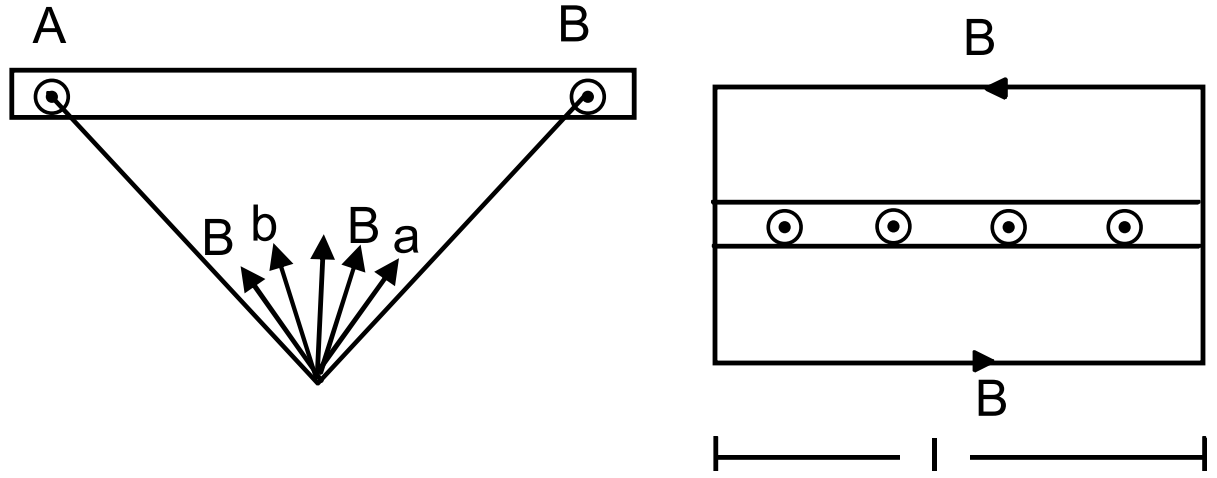
$\text{B}\times2\text{l}=\mu_0\text{K}_0\int\limits_\text{o}^\text{l}\text{dl}$

$\text{B}\times2\text{l}=\mu_0\text{Kl}\Rightarrow\text{B}=\frac{\mu_0\text{K}}{2}$

$\text{B}\times2\text{l}=\mu_0\text{K}_0\int\limits_\text{o}^\text{l}\text{dl}$

$\text{B}\times2\text{l}=\mu_0\text{Kl}\Rightarrow\text{B}=\frac{\mu_0\text{K}}{2}$

Since the $\overrightarrow{\text{B}}$ due to the 2 stripes are along the same direction, thus.
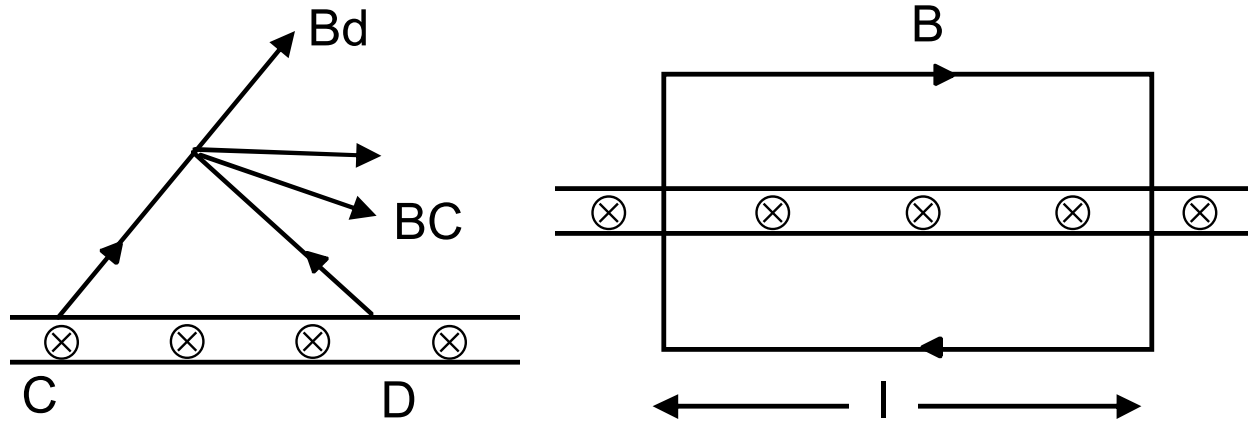
$\text{B}_\text{net}=\frac{\mu_0\text{K}}{2}+\frac{\mu_0\text{K}}{2}=\mu_0\text{k}$

Need a full question paper?

Generate a complete, print-ready paper with questions like this in minutes — across 16+ boards, with answer keys.
Start Generating Free

Similar questions

Find the speed of an electron with kinetic energy:
  1.  1eV
  2. 10keV
  3. 10MeV
In deriving Bernoulli’s equation, we equated the work done on the fluid in the tube to its change in the potential and kinetic energy.
  1. What is the largest average velocity of blood flow in an artery of diameter 2 × 10⁻³m if the flow must remain laminar?
  2. Do the dissipative forces become more important as the fluid velocity increases? Discuss qualitatively.
When an electron goes from the valence band to the conduction band in silicon, its energy is increased by 1.1eV. The average energy exchanged in a thermal collision is of the order of kT which is only 0.026eV at room temperature. How is a thermal collision able to take some of the electrons from the valence band to the conduction band?
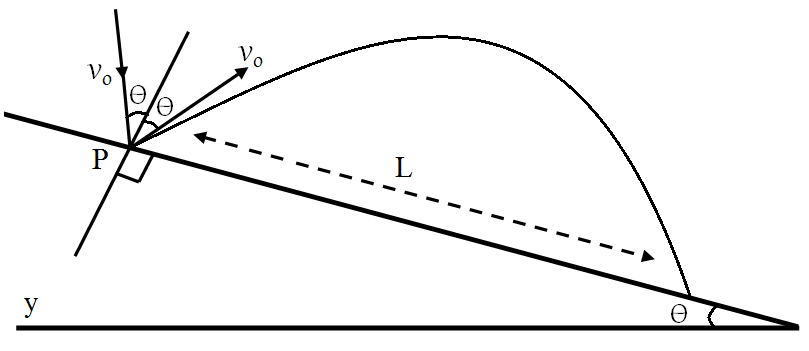
A particle falling vertically from a height hits a plane surface inclined to horizontal at an angle $\theta$ with speed $\text{v}_0$ and rebounds elastically. Find the distance along the plane where if will hit second time.

(Hint:

  1. After rebound, particle still has speed Vo to start.
  2. Work out angle particle speed has with horizontal after it rebounds.
  3. Rest is similar to if particle is projected up the incline.
A curved surface is shown in. The portion BCD is free of friction. There are three spherical balls of identical radii and masses. Balls are released from rest one by one from A which is at a slightly greater height than C.

With the surface AB, ball 1 has large enough friction to cause rolling down without slipping, ball 2 has a small friction and ball 3 has a negligible friction.

  1. For which balls is total mechanical energy conserved?
  2. Which ball (s) can reach D?
  3. For balls which do not reach D, which of the balls can reach back A?
A woman starts from her home at 9.00 am, walks with a speed of 5km h–1 on a straight road up to her office 2.5km away, stays at the office up to 5.00 pm, and returns home by an auto with a speed of 25km h–1. Choose suitable scales and plot the x-t graph of her motion.
A marble rolls along a table at a constant speed of $1.00 m / s$ and then falls off the edge of the table to the floor 1.00 m below,
i. How long does the marble take to reach the floor?
ii. At what horizontal distance from the edge of the table does the marble land?
iii. What is its velocity as it strikes the floor?
Show that a(b × c) is equal in magnitude to the volume of the parallelepiped formed on the three vectors a, b and c.
Establish the following vector inequalities geometrically or otherwise:

$|\text{a}-\text{b}|\ge||\text{a}|-|\text{b}||$

When does the equality sign above apply?

Two wires carrying equal currents i each, are placed perpendicular to each other, just avoiding a contact. If one wire is held fixed and the other is free to move under magnetic forces, what kind of motion will result?