MCQ
Two lines of force due to a bar magnet
  • A
    Intersect at the neutral point
  • B
    Intersect near the poles of the magnet
  • C
    Intersect on the equatorial axis of the magnet
  • Do not intersect at all

Answer

Correct option: D.
Do not intersect at all
d
(d)

Need a full question paper?

Generate a complete, print-ready paper with questions like this in minutes — across 16+ boards, with answer keys.

Start Generating Free

Similar questions

In a Young's double slit experiment, the intensity at a point is $\left(\frac{1}{4}\right)^{\text {th }}$ of the maximum intensity, the minimum distance of the point from the central maximum is  . . . . . . . . $\mu \mathrm{m}$.

(Given : $\lambda=600 \mathrm{~nm}, d=1.0 \mathrm{~mm}, \mathrm{D}=1.0 \mathrm{~m}$ )
A direct current of $5\,A$ is superposed on an alternating current $I =10 \sin \omega t$ flowing through the wire. The effective value of the resulting current will be
A convex lens is made of a material having refractive index $1.2$. Both the surfaces of the lens are convex. If it is dipped into water $(\mu=1.33),$ it will behave like:
A radioactive nucleus with $Z$ protons and $N$ neutrons emits an $\alpha - $ particle, $2\beta$- particles and $2$ gamma rays. The number of protons and neutrons in the nucleus left after the decay respectively, are
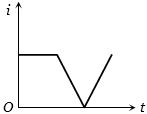
The current $i$ in an induction coil varies with time $t$ according to the graph shownin figure. Which of the following graphs shows the induced emf $(E$) in the coil with time
A particle of mass $m$ and charge $q$ moves with a constant velocity $v$ along the positive $x$ direction. It enters a region containing a uniform magnetic field $B$ directed along the negative $z$ direction, extending from $x = a$ to $x = b$. The minimum value of $v$ required so that the particle can just enter the region $x > b$ is
Two plates are $2\,cm$ apart, a potential difference of $10\;volt$ is applied between them, the electric field between the plates is.........$N/C$
A galaxy is observed to be moving with a velocity of $8600 km-sec^{-{1}}$. If it is at a distance of $430$ million light year from us, Hubble constant and corresponding age of the universe are respectively
In the Bohr model of the hydrogen atom, let $R, v$ and $E$ represent the radius of the orbit, the speed of electron and the total energy of the electron respectively. Which of the following quantity is proportional to the quantum number $n$
Fusion reaction takes place at very high temperature because: