Question
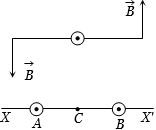
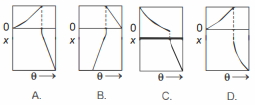
Two long parallel wires are at a distance $2d$ apart. They carry steady equal currents flowing out of the plane of the paper, as shown. The variation of the magnetic field $B$ along the line $XX’$ is given by
Answer

(b) If the current flows out of the paper, the magnetic field at points to the right of the wire will be upwards and to the left will be downward. Now magnetic field at $C$, is zero. The field in the region $BX'$ will be upwards $(+ve)$ because all points lying in this region are to the right of both the wires. Similarly, magnetic field in the region $AX$ will be downwards $(-ve)$. The field in the region $AC$ will be upwards $(+ve)$ because points are closer to $A$ compared to $B$. Similarly magnetic field in region $BC$ will be downward $(-ve)$. Graph $(b)$ satisfies all these conditions.
 

Need a full question paper?

Generate a complete, print-ready paper with questions like this in minutes — across 16+ boards, with answer keys.
Start Generating Free

Similar questions

If $r$ represents the radius of the orbit of a satellite of mass $m$ moving around a planet of mass $ M$, the velocity of the satellite is given by
A small sphere of radius $r$ falls from rest in a viscous liquid. As a result, heat is produced due to viscous force. The rate of production of heat when the sphere attains its terminal velocity, is proportional to
One end of string of length $l$ is connected to a particle of mass $'m'$ and the other end is connected to a small peg on a smooth horizontal table. If the particle moves in circle with speed $'v',$ the net force on the particle (directed towards centre) will be ($T$ represents the tension in the string) 
Two electrons are separated by a distance of $1\,\mathop A\limits^o $. What is the coulomb force between them
A ray of light originates from inside a glass slab and is incident on its inner surface at an angle $\theta$ as shown below. In this experiment, the location $x$ of the spot where the ray hits the screen is recorded. Which of the following correctly shows the plot of variation of $x$ with the angle $\theta$ ?
The particles $A$ and $B$ of mass $m$ each are separated by a distance $r$. Another particle $C$ of mass $M$ is placed at the midpoint of $A$ and $B$. Find the work done in taking $C$ to a point equidistant $r$ from $A$ and $B$ without acceleration $(G=$ Gravitational constant and only gravitational interaction between $A, B$ and $C$ is considered) 
The height of a waterfall is $84$ metre. Assuming that the entire kinetic energy of falling water is converted into heat, the rise in temperature of the water will be  $(g = 9.8\,m/{s^2},\;J = 4.2\,joule/cal)$
Two moles of benzaldehyde and one mole of acetone under alkaline conditions using aqueous $\mathrm{NaOH}$ after heating gives $x$ as the major product. The number of $\pi$ bonds in the product $x$ is.................
If a body is thrown up with the velocity of $15 \,m/s$ then maximum height attained by the body is..........$m$ ($g = 10\,m/{s^2}$)
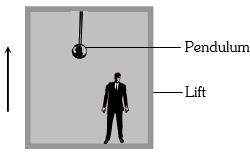
A man measures the period of a simple pendulum inside a stationary lift and finds it to be $T$ sec. If the lift accelerates upwards with an acceleration $\frac{g}{4}$, then the period of the pendulum will be