Two long straight parallel conductors separated by a distance of $0.5\,m$ carry currents of $5\,A$ and $8\,A$ in the same direction. The force per unit length experienced by each other is
Easy
Download our app for free and get started
(a) $F = {10^{ - 7}}\frac{{2{i_1}{i_2}}}{a} = {10^{ - 7}} \times \frac{{2 \times 5 \times 8}}{{0.5}}$$ = 1.6 \times {10^{ - 5}}$(Attractive)

Download our appand get started for free
Experience the future of education. Simply download our apps or reach out to us for more information. Let's shape the future of learning together!No signup needed.*
Similar Questions
- 1View SolutionWhat is the net force on the square coil
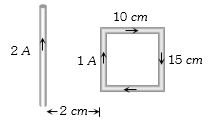
- 2A solenoid of length $0.5 \mathrm{~m}$ has a radius of $1 \mathrm{~cm}$ and is made up of ' $m$ ' number of turns. It carries a current of $5 \mathrm{~A}$. If the magnitude of the magnetic field inside the solenoid is $6.28 \times 10^{-3} \mathrm{~T}$, then the value of $m$ is :View Solution
- 3A long straight wire is carrying current $I_1$ in $+z$ direction. The $x-y$ plane contains a closed circular loop carrying current $I_2$ and not encircling the straight wire. The force on the loop will be:View Solution
- 4At what distance for a long straight wire carrying a current of $12\, A$ will the magnetic field be equal to $3 \times 10^{-5} Wb / m ^{2}$ ?View Solution
- 5View SolutionIf two streams of protons move parallel to each other in the same direction, then they
- 6View SolutionUnit of magnetic permeability is
- 7A galvanometer coil has $500$ turns and each turn has an average area of $3 \times 10^{-4}\, m ^{2}$. If a torque of $1.5\,Nm$ is required to keep this coil parallel to magnetic field when a current of $0.5\, A$ is flowing through it, the strength of the field (in $T )$ isView Solution
- 8A semicircular ring of radius $R$ carrying current $i$ is placed in a magnetic field of intensity $B$ so that plane of wire is perpendicular to magnetic field as shown. Net force acting on the ring isView Solution
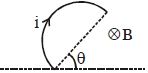
- 9A straight steel wire of length $‘\ell ’$ has a magnetic moment $‘M’$. It is bent in $L-$ shape. The new magnetic moment isView Solution

- 10An infinitely long wire, located on the $z$-axis, carries a current $/$ along the $+z$-direction and produces the magnetic field $\vec{B}$. The magnitude of the line integral $\int \vec{B} \cdot d l$ along a straight line from the point $(-\sqrt{3} a, a, 0)$ to $(a, a, 0)$ is given by [ $\mu_0$ is the magnetic permeability of free space.]View Solution