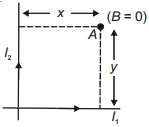
Two long straight wires are placed along $x$-axis and $y$-axis. They carry current $I_1$ and $I_2$ respectively. The equation of locus of zero magnetic induction in the magnetic field produced by them is
Medium


Download our appand get started for free
Experience the future of education. Simply download our apps or reach out to us for more information. Let's shape the future of learning together!No signup needed.*
Similar Questions
- 1A rectangular loop of wire shown below is coplanar with a long wire carrying current $I$. The loop is pulled to the right a s indicated. What are the directions of the induced current in the loop and the magnetic forces on the left and the right sides of the loop?View Solution
Induced current Force on left side Force on right side $a.$ Counter clockwise To the left To the right $b.$ clockwise To the left To the right $c.$ Counter clockwise To the right To the left $d.$ clockwise To the right To the left 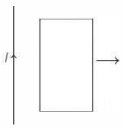
- 2charged particle with charge $q$ enters a region of constant, uniform and mutually orthogonal fields $\vec E$ and $\vec B$ with a velocity $\vec v$ perpendicular to both $\vec E$ and $\vec B$ , and comes out without any change in magnitude or direction of $\vec v$ . ThenView Solution
- 3Magnetic field due to a ring having $n$ turns at a distance $x$ on its axis is proportional to (if $r$ = radius of ring)View Solution
- 4View SolutionThe radius of circular path of an electron when subjected to a perpendicular magnetic field is
- 5A proton, a deuteron and an $\alpha-$particle with same kinetic energy enter into a uniform magnetic field at right angle to magnetic field. The ratio of the radii of their respective circular paths isView Solution
- 6View SolutionThe resistance of an ideal ammeter is
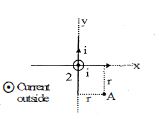
- 7Three infinite wires are arranged in space in three dimensions.(along $x, y$ and $z$ axis) as shown. Each wire carries current $i$ . Find magnetic field at $A$View Solution
- 8A galvanometer coil has a resistance $90\, \Omega$ and full scale deflection current $10\, mA$ . A $910\,\Omega$ resistance is connected in series with the galvanometer to make a voltmeter. If the least count of the voltmeter is $0.1\,V$, the number of divisions on its scale isView Solution
- 9A current of $0.1\, A$ circulates around a coil of $100$ $turns$ and having a radius equal to $5\,cm$. The magnetic field set up at the centre of the coil is ($\mu_0 = 4\pi \times 10^{-7} weber/amp-metre$)View Solution
- 10An electron, a proton, a deuteron and an alpha particle, each having the same speed are in a region of constant magnetic field perpendicular to the direction of the velocities of the particles. The radius of the circular orbits of these particles are respectively $R_e, R_p, R_d \,$ and $\, R_\alpha$. It follows thatView Solution