Magnetic field due to a ring having $n$ turns at a distance $x$ on its axis is proportional to (if $r$ = radius of ring)
Medium


Download our appand get started for free
Experience the future of education. Simply download our apps or reach out to us for more information. Let's shape the future of learning together!No signup needed.*
Similar Questions
- 1A thin disc of radius $R$ and mass $M$ has charge $q$ uniformly distributed on it. It rotates with angular velocity $\omega$. The ratio of magnetic moment and angular momentum for the disc isView Solution
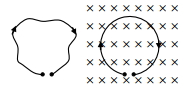
- 2A thin flexible wire of length $\mathrm{L}$ is connected to two adjacent fixed points and carries a current $\mathrm{I}$ in the clockwise direction, as shown in the figure. When the system is put in a uniform magnetic field of strength $B$ going into the plane of the paper, the wire takes the shape of a circle. The tension in the wire isView Solution
- 3A galvanometer whose resistance is $120\,\Omega $ gives full scale deflection with a current of $0.05\, A$ so that it can read a maximum current of $10\, A$. A shunt resistance is added in parallel with it. The resistance of the ammeter so formed is .............. $\Omega $View Solution
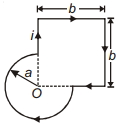
- 4The magnetic field intensity at the point $O$ of a loop with current $i$, whose shape is illustrated below isView Solution
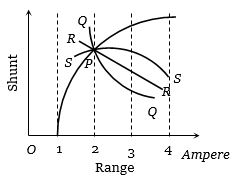
- 5The ammeter has range $1\, ampere$ without shunt. the range can be varied by using different shunt resistances. The graph between shunt resistance and range will have the natureView Solution
- 6View SolutionWhen a magnetic field is applied in a direction perpendicular to the direction of cathode rays, then their
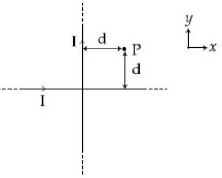
- 7Two very long, straight and insulated wires are kept at $90^o$ angle from each other In $xy -$ plane as shown in the figure. These wires carry current of equal magnitude $I$, whose directions are shown in the figure. The net magnetic field at point $P$ will beView Solution
- 8A positive charge $'q'$ of mass $'m'$ is moving along the $+ x$ axis. We wish to apply a uniform magnetic field $B$ for time $\Delta t$ so that the charge reverses its direction crossing the $y$ axis at a distance $d.$ ThenView Solution
- 9A circular coil has moment of inertia $0.8 \,kg m ^{2}$ around any diameter and is carrying current to roduce a magnetic moment of $20\, Am ^{2}$. The coil is kept initially in a vertical position and it can rotate freely around a horizontal diameter. When a uniform magnetic field of $4\, T$ is applied along the vertical, it starts rotating around its horizontal diameter. The angular speed the coil acquires after rotating by $60^{\circ}$ will beView Solution
- 10A galvanometer having a coil resistance $100 \;\Omega$ gives a full scale deflection when a current of $1 \;\mathrm{mA}$ is passed through it. What is the value of the resistance which can convert this galvanometer into a voltmeter giving full scale deflection for a potential difference of $10\; \mathrm{V} ?$......$k\Omega$View Solution