One mole of a monatomic ideal gas undergoes the cyclic process $J \rightarrow K \rightarrow L \rightarrow M \rightarrow J$, as shown in the $P - T$ diagram.
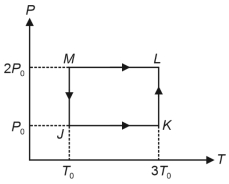
Match the quantities mentioned in $List-I$ with their values in $List-II$ and choose the correct option. [ $R$ is the gas constant]
| $List-I$ | $List-II$ |
| ($P$) Work done in the complete cyclic process | ($1$) $R T_0-4 \ R T_0 \ln 2$ |
| ($Q$) Change in the internal energy of the gas in the process $JK$ | ($2$) $0$ |
| ($R$) Heat given to the gas in the process $KL$ | ($3$) $3 \ R T_0$ |
| ($S$) Change in the internal energy of the gas in the process $MJ$ | ($4$) $-2 \ R T_0 \ln 2$ |
| ($5$) $-3 \ R T_0 \ln 2$ |
IIT 2024, Advanced
Download our app for free and get started
$J \left( P _0, V _0, T _0\right)$
$K \left( P _0, 3 V _0, 3 T _0\right)$
$M \left(2 P _0, \frac{ V _0}{2}, T _0\right)$
$L \left(2 P _0, \frac{3 V _0}{2}, 3 T _0\right)$
$P _0 V _0= nRT _0$
$JK \rightarrow \text { isobaric } \Rightarrow W = P _0\left(2 V _0\right)=2 nRT \text {. }$
$\Delta U =\frac{3}{2} nR \left(2 T _0\right)=3 nRT _0$
$KL \rightarrow \text { isothermal } \rightarrow W = nR (3 T ) \ln \left(\frac{1}{2}\right)=-3 nRT _0 \ln 2$
$\Delta U =0 \Rightarrow Q =-3 nRT _0 \ln 2$
$LM \rightarrow \text { isobaric }=2 P _0\left(- V _0\right)=-2 nRT _0$
$MJ \rightarrow \text { isothermal } \Rightarrow nRT _0 \ell n 2 ; \Delta U =0$
$WD _{ xat }=-2 nRT _0 \ln 2$
$P \rightarrow 4, Q \rightarrow 3, R \rightarrow 5, S \rightarrow 2$

Download our appand get started for free
Experience the future of education. Simply download our apps or reach out to us for more information. Let's shape the future of learning together!No signup needed.*
Similar Questions
- 1One mole of an ideal monoatomic gas undergoes the following four reversible processes:View Solution
Step $1$ It is first compressed adiabatically from volume $8.0 \,m ^{3}$ to $1.0 \,m ^{3}$.
Step $2$ Then expanded isothermally at temperature $T_{1}$ to volume $10.0 \,m ^{3}$.
Step $3$ Then expanded adiabatically to volume $80.0 \,m ^{3}$.
Step $4$ Then compressed isothermally at temperature $T_{2}$ to volume $8.0 \,m ^{3}$.
Then, $T_{1} / T_{2}$ is
- 2A hypothetical gas expands adiabatically such that its volume changes from $8$ litres to $27$ litres. If the ratio of final pressure of the gas to initial pressure of the gas is $\frac{16}{81}$. Then the ratio of $\frac{C_P}{C_V}$ will beView Solution
- 3An ideal gas is taken through a quasi-static process described by $P = \alpha\, V^2$, with $\alpha = 5\,atm/m^6$. The gas is expanded to twice its original volume of $1\,m^3$. How much work is done by the expanding gas in this processView Solution
- 4During an adiabatic process, if the pressure of a gas is found to be proportional to the cube of its absolute temperature, then the ratio of $\frac{C_p}{C_V}$ for the gas is:View Solution
- 5The volume of $1\; mole$ of an ideal gas with the adiabatic exponent $\gamma$ is changed according to the relation $V=\frac bT$ where $b =$ constant. The amount of heat absorbed by the gas in the process if the temperature is increased by $\triangle T$ will beView Solution
- 6If $R =$ universal gas constant, the amount of heat needed to raise the temperature of $2$ mole of an ideal monoatomic gas from $273K$ to $373K$ when no work is done ...... $R$View Solution
- 7An engineer claims to have made an engine delivering $10 kW$ power with fuel consumption of $1 g/sec$. The calorific value of the fuel is $2 kcal/g$. Is the claim of the engineerView Solution
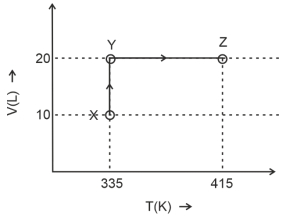
- 8Consider the following volume-temperature $( V - T )$ diagram for the expansion of $5$ moles of an ideal monoatomic gas.View Solution
Considering only $P-V$ work is involved, the total change in enthalpy (in Joule) for the transformation of state in the sequence $X \rightarrow Y \rightarrow Z$ is $\qquad$
[Use the given data: Molar heat capacity of the gas for the given temperature range, $C _{ v , m }=12 J K ^{-1} mol ^{-1}$ and gas constant, $R =8.3 J K ^{-1} mol ^{-1}$ ]
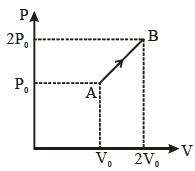
- 9The $P-V$ diagram of $2\,g$ of helium gas for a certain process $A$ $\to$ $B$ is shown in the figure. What is the heat given to the gas during the process $A$ $\to$ $B$?View Solution
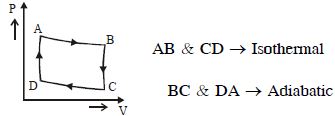
- 10The $P-V$ diagram of a certain process (carnot cycle) is as shown. The process is also represent asView Solution