Question
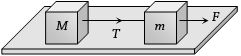
Two masses $M$ and $m$ are connected by a weightless string. They are pulled by a force $F$ on a frictionless horizontal surface., the acceleration of mass $m$ is
Answer

(b) Net force on mass $m$, $ma = F - T$$\therefore $ $a = \frac{{F - T}}{m}$

Need a full question paper?

Generate a complete, print-ready paper with questions like this in minutes — across 16+ boards, with answer keys.
Start Generating Free

Similar questions

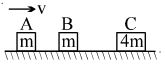
Three blocks are initially placed as shown in the figure. Block $A$ has mass $m$ and initial velocity $v$ to the right. Block $B$ with mass $m$ and block $C$ with mass $4m$ are both initially at rest. Neglect friction. All collisions are elastic. The final velocity of block $A$ is
The escape speed of a projectile on the earth's surface is $11.2\; km s ^{-1} .$ A body is projected out with thrice this speed. What is the speed (in $km/s$) of the body far away from the earth? Ignore the presence of the sun and other planets.
A cable of resistance $10\,\Omega $ carries electric power from a generator producing $250\, kW$ at $10000\, volt$, the power lost in the cable during transmission is ............. $kW$
On a foggy day, two drivers spot each other when $80\, m$ apart. They were travelling at $70\, km/h$ and $60\, km/h$. Both apply brakes simultaneously which retard the cars at the rate of $5\, ms^{-2}$. Which of the following statements is correct ?
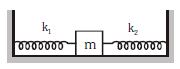
A block of mass $m$ is attached to two springs of spring constants $k_1$ and $k_2$ as shown in figure. The block is displaced by $x$ towards right and released. The velocity of the block when it is at $x/2$ will be
Assertion : Energy is released in nuclear fission.

Reason : Total binding energy of the fission fragments is larger than the total binding energy of the parent nucleus
The blades of a windmill sweep out a circle of area $A$. If the wind flows at a velocity $b$ perpendicular to the circle, then the mass of the air of density $\rho $ passing through it in time $t$ is
The acceleration of a particle is increasing linearly with time $t$ as $bt$. The particle starts from the origin with an initial velocity ${v_0}$. The distance travelled by the particle in time $t$ will be
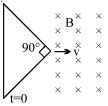
The figure shows an isosceles triangle wire frame with apex angle equal to $\pi /2$. The frame starts entering into the region of uniform magnetic field $B$ with constant velocity $v$ at $t= 0$. The longest side of the frame is perpendicular to the direction of velocity. If $i$ is the instantaneous current through the frame then choose the alternative showing the correct variation of $i$ with time.
A prism of refractive index $\sqrt 2 $ has a refracting angle of $60^o$. At what angle a ray must be incident on it so that it suffers a minimum deviation.....$^o$