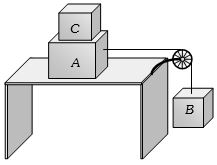
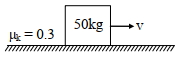
A heavy box of mass $50 \mathrm{~kg}$ is moving on a horizontal surface. If co-efficient of kinetic friction between the box and horizontal surface is $0.3$ then force of kinetic friction is :
JEE MAIN 2024, Difficult
Download our app for free and get started
$\mathrm{F}_{\mathrm{L}}=\mu_{\mathrm{L}} \mathrm{N}=0.3 \times 50 \times 9.8=147 \mathrm{~N}$

Download our appand get started for free
Experience the future of education. Simply download our apps or reach out to us for more information. Let's shape the future of learning together!No signup needed.*
Similar Questions
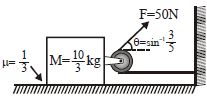
- 1In the given figure the acceleration of $M$ is $(g = 10 \,ms^{-2})$View Solution
- 2A hemispherical bowl of radius $r$ is set rotating about its axis of symmetry in vertical. A small block kept in the bowl rotates with bowl without slipping on its surface. If the surface of the bowl is smooth and the angle made by the radius through the block with the vertical is $\theta$, then find the angular speed at which the ball is rotating.View Solution
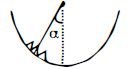
- 3An insect crawls up a hemispherical surface very slowly. The coefficient of friction between the insect and the surface is $1/3$. If the line joining the centre of the hemispherical surface to the insect makes an angle $\alpha $ with the vertical, the maximum possible value of $\alpha $ so that the insect does not slip is given byView Solution
- 4A body of mass $4\, kg$ is at rest on a horizontal table. The coefficient of friction between the body and the table is $0.2$ . A horizontal force of $6N$ is applied on the body. The acceleration of the body is .......... $m/s^2$View Solution
- 5Two balls of masses ${m_1}$ and ${m_2}$ are separated from each other by a powder charge placed between them. The whole system is at rest on the ground. Suddenly the powder charge explodes and masses are pushed apart. The mass ${m_1}$ travels a distance ${s_1}$ and stops. If the coefficients of friction between the balls and ground are same, the mass ${m_2}$ stops after travelling the distanceView Solution
- 6......... $m/s^2$ is magnitude of acceleration of a block moving with speed $10\,m/s$ on a rough surface if coefficient of friction is $0.2$.View Solution
- 7A particle of mass $m$ is executing uniform circular motion on a path of radius $r$. If $p$ is the magnitude of its linear momentum. The radial force acting on the particle isView Solution
- 8A mass is supported on a frictionless horizontal surface. It is attached to a string and rotates about a fixed centre at an angular velocity ${\omega _0}$. If the length of the string and angular velocity are doubled, the tension in the string which was initially ${T_0}$ is nowView Solution
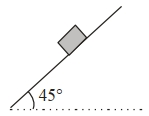
- 9Consider a block kept on an inclined plane (inclined at $45^{\circ}$ ) as shown in the figure. If the force required to just push it up the incline is $2$ times the force required to just prevent it from sliding down, the coefficient of friction between the block and inclined plane $(\mu)$ is equal toView Solution
- 10Two masses $A$ and $B$ of $10\, kg$ and $5 \,kg$ respectively are connected with a string passing over a frictionless pulley fixed at the corner of a table as shown. The coefficient of static friction of $A$ with table is $0.2$. The minimum mass of $C$ that may be placed on $A$ to prevent it from moving is ........ $kg$View Solution