Two metal spheres $A$ and $B$ of radii $a$ and $b(a < b)$ respectively are at a large distance apart. Each sphere carries a charge of $100 \mu C$. The spheres are connected by a conducting wire, then
Easy


Download our appand get started for free
Experience the future of education. Simply download our apps or reach out to us for more information. Let's shape the future of learning together!No signup needed.*
Similar Questions
- 1View SolutionWhen a parallel plates capacitor is connected to a source of constant potential difference,
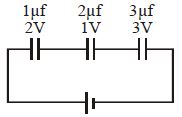
- 2The diagram shows three capacitors with their capacitances and with breakdown voltages. What should be the maximum value of external $emf$ of source such that no capacitor breaks downView Solution
- 3Three capacitors of $2\,\mu F,\,3\,\mu F$ and $6\,\mu F$ are joined in series and the combination is charged by means of a $24\, volt$ battery. The potential difference between the plates of the $6\,\mu F$ capacitor is.......$volt$View Solution
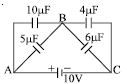
- 4In the circuit shown in figure, four capacitors are connected to a battery. The potential difference across the $6$ $\mu F$ capacitor is......$V$View Solution
- 5A parallel plate air capacitor has a capacitance $C$. When it is half filled with a dielectric of dielectric constant $5$, the percentage increase in the capacitance will be......$\%$View Solution
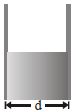
- 6A capacitor of capacitance $15 \,nF$ having dielectric slab of $\varepsilon_{r}=2.5$ dielectric strength $30 \,MV / m$ and potential difference $=30\; volt$ then the area of plate is ....... $ \times 10^{-4}\; m ^{2}$View Solution
- 7A solid conducting sphere of radius $a$ has a net positive charge $2Q$. A conducting spherical shell of inner radius $b$ and outer radius $c$ is concentric with the solid sphere and has a net charge $-Q$. The surface charge density on the inner and outer surfaces of the spherical shell will beView Solution
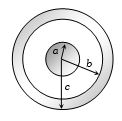
- 8A $500 \,\mu F$ capacitor is charged at a steady rate of $100\, \mu C/sec$. The potential difference across the capacitor will be $10\, V$ after an interval of.....$sec$View Solution
- 9An electric dipole moment $\vec p = (2.0\hat i + 3.0\hat j)$ $\mu C. $ $m$ is placed in a uniform electric field $\vec E = (3.0\hat i + 2.0\hat k)$ $×$$10^5$ $N$ $C^{-1}$.View Solution
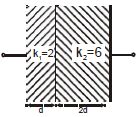
- 10View SolutionA parallel plate capacitor has two layers of dielectrics as shown in fig. This capacitor is connected across a battery, then the ratio of potential difference across the dielectric layers is