Two metal wires of identical dimensions are connected in series. If $\sigma _1$ and $\sigma _2$ are the conductivities of the metal wires respectively, the effective conductivity of the combination is
AIPMT 2015,JEE MAIN 2022, Medium



Download our appand get started for free
Experience the future of education. Simply download our apps or reach out to us for more information. Let's shape the future of learning together!No signup needed.*
Similar Questions
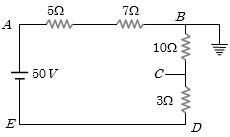
- 1In the circuit shown, the point ‘$B$’ is earthed. The potential at the point ‘$A$’ is ............. $V$View Solution
- 2An ammeter $A$ of finite resistance, and a resistor $R$ are joined in series to an ideal cell $C$. $A$ potentiometer $P$ is joined in parallel to $R$. The ammeter reading is $I_0$ and the potentiometer reading is $V_0$. $P$ is now replaced by a voltmeter of finite resistance. The ammeter reading now is $I$ and the voltmeter reading is $V$.View Solution

- 3The specific resistance of a wire is $\rho $, its volume is $3\,{m^3}$ and its resistance is $3\, ohms$, then its length will beView Solution
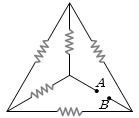
- 4In the network shown in the figure, each of the resistance is equal to $2\,\Omega $. The resistance between the points $A$ and $B$ is .............. $\Omega$View Solution
- 5If a $2\, kW$ boiler is used everyday for $1$ hour, then electrical energy consumed by boiler in thirty days is .......... $uint$View Solution
- 6View SolutionIdentify the set in which all the three materials are good conductors of electricity
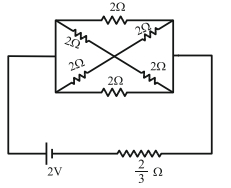
- 7In the following circuit, the battery has an emf of $2\mathrm{V}$ and an internal resistance of $\frac{2}{3}\ \Omega$. The power consumption in the entire circuit is$..... W.$View Solution
- 8One $kg$ of water, at $20\,^oC$, is heated in an electric kettle whose heating element has a mean (temperature averaged) resistance of $20\, \Omega $. The rms voltage in the mains is $200\, V$. Ignoring heat loss from the kettle, time taken for water to evaporate fully, is close to.......... $\min$ [Specific heat of water $= 4200\, J/kg\, ^oC$), Latent heat of water $= 2260\, k\,J/kg$]View Solution
- 9Time taken by a $836\; W$ heater to heat $1\; litre$ of water from $10^{\circ} C$ to $40^{\circ} C$ isView Solution
- 10A potentiometer is connected between $A$ and $B$ and the balance point is obtained at $203. 6\,cm$. When the end of the potentiometer connected to $B$ is shifted to $C$, then the balance point is obtained at $24.6\,cm$. If now the potentiometer be connected between $B$ and $C$, the balance point will be at ................. $cm$View Solution
