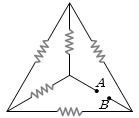
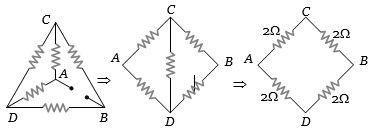
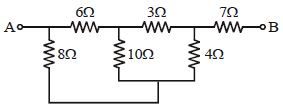
In the network shown in the figure, each of the resistance is equal to $2\,\Omega $. The resistance between the points $A$ and $B$ is .............. $\Omega$
AIPMT 1995, Easy


Download our appand get started for free
Experience the future of education. Simply download our apps or reach out to us for more information. Let's shape the future of learning together!No signup needed.*
Similar Questions
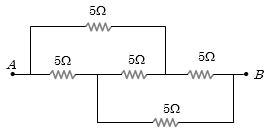
- 1Effective resistance between $A$ and $B$ is ........... $\Omega$View Solution
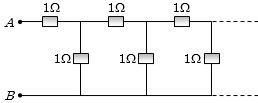
- 2The equivalent resistance between points $A$ and $B$ of an infinite network of resistances each of $1\,\Omega $ connected as shown, isView Solution
- 3Four wires of equal length and of resistances $10$ $ ohms$ each are connected in the form of a square. The equivalent resistance between two opposite corners of the square is ............. $ohm$View Solution
- 4Equivalent resistance between the adjacent corners of a regular $n$-sided polygon of uniform wire of resistance $R$ would be:View Solution
- 5Three resistances $P, Q, R$ each of $2 \,\,\Omega$ and an unknown resistance $S$ form the four arms of a Wheatstone bridge circuit. When a resistance of $6 \,\,\Omega$ is connected in parallel to $S$ the bridge gets balanced. What is the value of $S\,?$ ............... $\Omega$View Solution
- 6An insulating pipe of cross-section area $'A'$ contains an electrolyte which has two types of ions $\rightarrow$ their charges being $-e$ and $+2e$. $A$ potential difference applied between the ends of the pipe result in the drifting of the two types of ions, having drift speed $= v$ ($-ve$ ion) and $v/4$ ($+ve$ ion). Both ions have the same number per unit volume $= n$. The current flowing through the pipe isView Solution
- 7The equivalent resistance between the points $A$ and $B$ is :-View Solution
- 8The electromotive force of a primary cell is $2\, volts$. When it is short-circuited it gives a current of $4$ amperes. Its internal resistance in $ohms$ isView Solution
- 9If two wires having resistance $R$ and $2R$. Both joined in series and in parallel then ratio of heat generated in this situation, applying the same voltage,View Solution
- 10Current density in a cylindrical wire of radius $R$ is given as $J =$ $\left\{ {\begin{array}{*{20}{c}}View Solution
{{J_0}\left( {\frac{x}{R} - 1} \right)\,\,for\,\,0 \leqslant x < \frac{R}{2}} \\
{{J_0}\frac{x}{R}\,\,\,\,for\,\,\,\frac{R}{2} \leqslant x \leqslant R}
\end{array}} \right.$The current flowing in the wire is: