MCQ
Two mutually perpendicular simple harmonic vibrations have same amplitude, frequency and phase. When they superimpose, the resultant form of vibration will be
  • A
    A circle
  • B
    An ellipse
  • A straight line
  • D
    A parabola

Answer

Correct option: C.
A straight line
If $y_1=a_1 \sin \omega t$ and $y_2=a_2 \sin (\omega t+0)=a_2 \sin \omega t$
$\Rightarrow \frac{y_1^2}{a_1^2}+\frac{y_2^2}{a_2^2}-\frac{2 y_1 y_2}{a_1 a_2}=0$
$\Rightarrow y_2=\frac{a_2}{a_1} y_1$
This is the equation of straight line.

Need a full question paper?

Generate a complete, print-ready paper with questions like this in minutes — across 16+ boards, with answer keys.
Start Generating Free

Similar questions

When a $P N$ junction diode is reverse biased
lmage formed by a convex mirror is
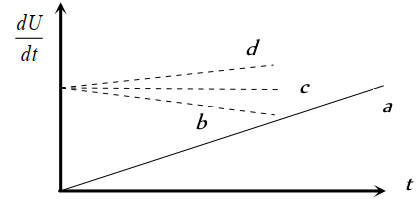
A constant current $i$ is passed through a resistor. Taking the temperature coefficient of resistance into account, indicate which of the plots shown in figure best represents the rate of production of thermal energy in the resistor Image
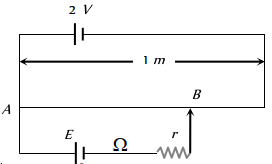
In the given figure, battery $E$ is balanced on $55 \mathrm{~cm}$ length of potentiometer wire but when a resistance of $10 \Omega$ is connected in parallel with the battery then it balances on $50 \mathrm{~cm}$ length of the potentiometer wire then internal resistance $r$ of the battery is

Image

In a triode valve the amplification factor is $20$ and mutual conductance is $10$ mho. The plate resistance is
A metal ball immersed in alcohol weighs $W_1$ at $0^{\circ} \mathrm{C}$ and $W_2$ at $59^{\circ} \mathrm{C}$. The coefficient of cubical expansion of the metal is less than that of alcohol. Assuming that the density of metal is large compared to that of alcohol, it can be shown that
A $2 m$ long rod of radius $1 cm$ which is fixed from one end is given a twist of 0.8 radians. The shear strain developed will be
You are given several identical resistances each of value $R=10 \Omega$ and each capable of carrying maximum current of $1$ ampere. lt is required to make a suitable combination of these resistances to produce a resistance of $5 \Omega$ which can carry a current of $4$ amperes. The minimum number of resistances of the type $R$ that will be required for this job
A ball hits a vertical wall horizontally at $10 \mathrm{~m} / \mathrm{s}$ bounces back at 10 $\mathrm{m} / \mathrm{s}$
A projectile is projected with velocity $k v_e$ in vertically upward direction from the ground into the space. ( $v_e$ is escape velocity and $k<1$ ). If air resistance is considered to be negligible then the maximum height from the centre of earth to which it can go, will be $:(R=$ radius of earth $)$