MCQ
Two objects are projected with same velocity ' $u$ ' however at different angles $\alpha$ and $\beta$ with the horizontal. If $\alpha+\beta=90^{\circ}$, the ratio of horizontal range of the first object to the $2^{\text {nd }}$ object will be :
  • A
    $4: 1$
  • B
    $2: 1$
  • C
    $1: 2$
  • $1: 1$

Answer

Correct option: D.
$1: 1$
d
$\text { Range }=\frac{ u ^2 \sin 2 \theta}{ g }$

Range for projection angle " $\alpha$ "

$R _1=\frac{ u ^2 \sin 2 \alpha}{ g }$

Range for projection angle " $\beta$ "

$R _2=\frac{ u ^2 \sin 2 \beta}{ g }$

$\alpha+\beta=90^{\circ}(\text { Given })$

$\Rightarrow \beta=90^{\circ}-\alpha$

$R _2=\frac{ u ^2 \sin 2\left(90^{\circ}-\alpha\right)}{ g }$

$R _2=\frac{ u ^2 \sin \left(180^{\circ}-2 \alpha\right)}{ g }$

$R _2=\frac{ u ^2 \sin 2 \alpha}{ g }$

$\Rightarrow \frac{ R _1}{ R _2}=\frac{\left(\frac{ u ^2 \sin 2 \alpha}{ g }\right)}{\left(\frac{ u ^2 \sin 2 \alpha}{ g }\right)}=\frac{1}{1}$
Need a full question paper?

Generate a complete, print-ready paper with questions like this in minutes — across 16+ boards, with answer keys.

Start Generating Free

Similar questions

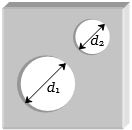
Two holes of unequal diameters $d_1$ and $d_2$ $({d_1} > {d_2})$ are cut in a metal sheet. If the sheet is heated
An object is projected upwards with a velocity of $100 \,m/s$. It will strike the ground after (approximately)........$sec$
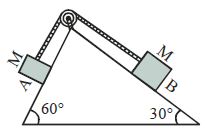
Two blocks each of mass $M$ are resting on a frictionless inclined plane as shown in figure. Then
A disc and a ring of same mass are rolling and if their kinetic energies are equal, then the ratio of their velocities will be
Calculate the RMS velocity of molecules of a gas of which the ratio of two specific heats is 1.42 and velocity of sound in the gas is 500m/ s:
During the adiabatic expansion of $2 \,moles$ of a gas, the internal energy was found to have decreased by $100 J$. The work done by the gas in this process is ..... $J$
The potential energy function for the force between two atoms in a diatomic molecule is approximately given by $U(x)=$ $\;\frac{a}{{{x^{12}}}} - \frac{b}{{{x^6}}}$ where a and b are constants and $x $ is the distance between the atoms. If the dissociation energy of the molecule is $D = [ U ( x = \infty) - U_{ at\ equilibrium}], D$ is
A particle moves from the point $\left( {2.0\hat i + 4.0\hat j} \right)\,m$, at $t = 0$ with an initial velocity $\left( {5.0\hat i + 4.0\hat j} \right)\,m{s^{ - 1  }}$. It is acted upon by a constant force which produces a constant acceleration $\left( {4.0\hat i + 4.0\hat j} \right)\,m{s^{ - 2}}$. What is the distance of the particle from the origin at time $2\,s$
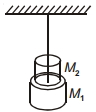
The length of wire, when $M_1$ is hung from it, is $I_1$ and is $I_2$ with both $M_1$ and $M_2$ hanging. The natural length of wire is ........
Two tuning forks $A$ and $B$ produce $8\  beats/s$ when sounded together. A gas column $37.5\  cm$  long in a pipe closed at one end resonate to its fundamental mode with fork $A$ whereas a column of length $38.5\  cm$ of the same gas in a similar pipe is required for a similar resonance with fork $B$. The frequencies of these two tuning forks, are