Question
Two objects of masses $m_1$ and $m$ having the same size are dropped simultaneously from heights $h_1$ and $h_2$ respectively. Find out the ratio of time they would take in reaching the ground. Will this ratio remain the same if
i. One of the objects is hollow and the other one is solid.
ii. Both of them are hollow, size remaining the same in each case. Give reason.
Answer

From secound equation of motion, $\text{h}=\text{ut}+\frac{1}{2}\ \text{gt}^2$
so, $\text{h}=\frac{1}{2}\ \text{gt}^2$
Where, $h =$ Displacement $u =$ initial velocity, $t =$ Time and $g =$ Acceleration due to gravity$\Rightarrow\text{gt}^2=2\text{h}\Rightarrow\text{t}^2=\frac{2\text{h}}{\text{g}}$
$\text{t}=\sqrt{\frac{2\text{h}}{\text{g}}}$
$\therefore$ Time taken by first boject of mass, $m_1$
$\text{t}_1=\sqrt{\frac{2\text{h}_1}{\text{g}}} [$for $II$ object $u = 0]$
Similarily time taken by object of mass $m_2$
​​​​​​​$\text{t}_2=\sqrt{\frac{2\text{h}_2}{\text{g}}}\Rightarrow\frac{\text{t}_1}{\text{t}_2}=\sqrt{\frac{\text{h}_1}{\text{h}_2}}$
Acceleration due to gravity is independent of mass of falling body.
so, the ratio remains the same. if bodies are hollow, then also ratio remains the same i.e., $\text{t}_1:\text{t}_2=\sqrt{\text{h}_1}:\sqrt{\text{h}_2}$

Need a full question paper?

Generate a complete, print-ready paper with questions like this in minutes — across 16+ boards, with answer keys.

Start Generating Free

Similar questions

Descibe general characters, classification and example of old division Spermatophyta.
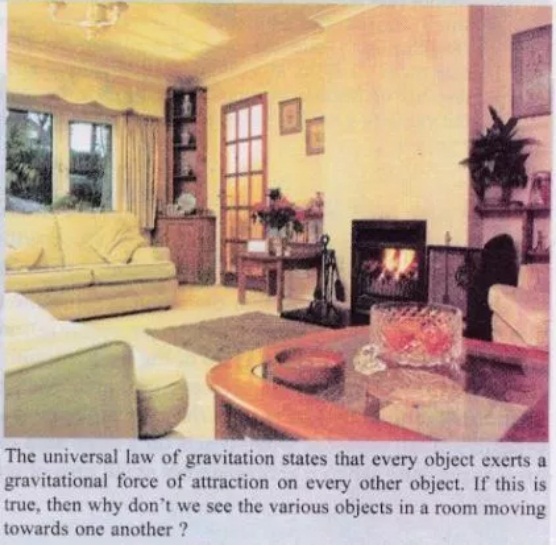
Universal law of gravitation states that every object exerts a gravitational force of attraction on every other object. If this is true, why don’t we notice such forces? Why don’t the two objects in a room move towards each other due to this force?
Write the differences between mass and weight of an object.
State and explain Newton’s second law of motion.
A car falls off a ledge and drops to the ground in $0.5 s .$ Let $g =10\ ms^{-2} ($for simplifying the calculations$).$
$i.$ What is its speed on striking the ground?
$ii.$ What is its average speed during the $0.5 s ?$
$iii.$ How high is the ledge from the ground?
Consider the following sound waves marked $A, B, C$ and $D:$
  1. Which two waves represent sounds of the same loudness but different pitch$?$
  1. Which two waves represent sounds of the same frequency but different loudness?
  1. State whether all these sound waves have been produced by the same vibrating body or different vibrating bodies?
  1. Which vibrating body/bodies could have generated the sound waves shown here$?$
What are the differences between the mass of the object and its weight?
Differentiate between pathogens and pests. How does an insect-pest attack the plants?
Non-metals are usually poor conductors of heat and electricity. They are non-lustrous, non-sonorous, nonmalleable and are coloured.
i. Name a lustrous non-metal.
ii. Name a non-metal which exists as a liquid at room temperature.
iii. The allotropic form of a non-metal is a good conductor of electricity. Name the allotrope.
iv. Name a non-metal which is known to form the largest number of compounds.
v. Name a non-metal other than carbon which shows allotropy.
vi. Name a non-metal which is required for combustion.
Differentiate between meristematic and permanent tissues in plants.