Two $P N$-junctions can be connected in series by three different methods as shown in the figure. If the potential difference in the junctions is the same, then the correct connections will be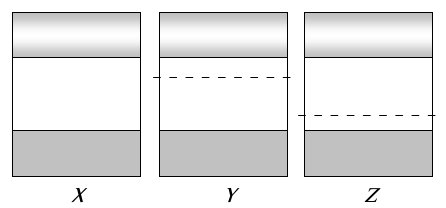
[IIT-JEE 1989]


Download our appand get started for free
Experience the future of education. Simply download our apps or reach out to us for more information. Let's shape the future of learning together!No signup needed.*
Similar Questions
- 1View SolutionWhich statement is correct
- 2A triode has a mutual conductance of $2 \times 10^{-3} mho$ and an amplification factor of $50.$ The anode is connected through a resistance of $25 \times 10^3$ ohms to a $250$ volts supply. The voltage gain of this amplifier isView Solution
- 3Consider the following statements $A$ and $B$ and identify the correct choice of the given answers(A) A zener diode is always connected in reverse bias(B) The potential barrier of a $P N$ junction lies between $0.1$ to $0.3\ V$ approximatelyView Solution
- 4Before the saturation state of a diode at the plate voltages of $400 V$ and $200 V$ respectively the currents are $i$ and $i$ respectively. The ratio $i / i$ will beView Solution
- 5If a full wave rectifier circuit is operating from $50 Hz$ mains, the fundamental frequency in the ripple will beView Solution
- 6View SolutionWhat is the current in the circuit shown below
- 7View SolutionWhich of the following semi-conductor diodes is reverse biased
- 8View SolutionThe value of amplification factor from the following graph will be
- 9Plate resistance of two triode valves is $2 k \Omega$ and $4 k \Omega$, amplification factor of each of the valves is $40.$ The ratio of voltage amplification, when used with $4 k \Omega$ load resistance, will beView Solution
- 10In a triode amplifier, $\mu=25, r_p=40$ kilo ohm and load resistance $R_L=10$ kilo ohm. If the input signal voltage is $0.5$ volt, then output signal voltage will beView Solution